Deutsch-Chinesische Enzyklopädie, 德汉百科
 IT-Times


 Companies

 History
 Science and technology

世界模型是一种生成模型,通过学习来表现和模拟环境。这些模型不依赖于预定义的标签,而是捕捉环境的动态并预测未来的状态。这使得人工智能系统能够对世界形成丰富的内部理解,类似于人类利用心理模拟来预测结果和做出决策。
世界模型由三种基本能力组成:
表征学习: 将高维感官数据(如图像、文本或视频)压缩为有意义的低维表征。
预测: 根据过去和现在的数据预测环境的未来状态。
规划和决策: 利用学习到的模型模拟不同的行动,并选择最佳行动方案。
Weltmodelle sind generative Modelle, die lernen, eine Umgebung darzustellen und zu simulieren. Anstatt sich auf vordefinierte Bezeichnungen zu verlassen, erfassen diese Modelle die Dynamik einer Umgebung und sagen zukünftige Zustände voraus. Dadurch können KI-Systeme ein umfassendes internes Verständnis der Welt entwickeln, ähnlich wie Menschen mentale Simulationen nutzen, um Ergebnisse vorherzusagen und Entscheidungen zu treffen.
Ein Weltmodell besteht aus drei grundlegenden Fähigkeiten:
Repräsentationslernen: Komprimierung hochdimensionaler sensorischer Daten (z. B. Bilder, Texte oder Videos) in eine aussagekräftige niedrigdimensionale Darstellung.
Vorhersage: Vorhersage des zukünftigen Zustands der Umgebung auf der Grundlage vergangener und gegenwärtiger Daten.
Planung und Entscheidungsfindung: Verwendung des gelernten Modells, um verschiedene Aktionen zu simulieren und die beste Vorgehensweise zu wählen.
World models are generative models that learn to represent and simulate an environment. Instead of relying on predefined labels, these models capture the dynamics of an environment and predict future states. This allows AI systems to develop a rich internal understanding of the world, akin to how humans use mental simulations to predict outcomes and make decisions.
A world model consists of three fundamental abilities:
Representation Learning: Compressing high-dimensional sensory data (e.g., images, text, or video) into a meaningful lower-dimensional representation.
Prediction: Forecasting the future state of the environment based on past and present data.
Planning and Decision-Making: Using the learned model to simulate different actions and choose the best course of action.
Architecture of World Models
A typical world model consists of three key components:
1. Vision Model (V): Perception and Representation Learning
- Uses a Variational Autoencoder (VAE) or similar architecture to encode high-dimensional inputs (like images or video frames) into a latent space.
- This compressed representation (latent vector z) captures essential features of the environment while filtering out irrelevant noise.
2. Memory Model (M): Learning Dynamics and Prediction
- Uses a Recurrent Neural Network (RNN) or a Transformer to model temporal dependencies in the environment.
- Often implemented with a Mixture Density Network (MDN-RNN), which predicts the probability distribution of future states.
- Helps the AI learn how actions influence the next state, allowing it to forecast future scenarios.
3. Controller ©: Decision-Making and Planning
- A lightweight policy network that uses the world model’s representations to decide actions.
- Instead of learning from raw data, it operates within the simulated environment created by the world model, making training more efficient.
This modular approach allows world models to be trained independently of the controller, leading to faster learning and more robust decision-making.
Real-World Applications of World Models
World models are revolutionizing multiple fields, from robotics to reinforcement learning and beyond. Let’s look at some fascinating applications.
1. Reinforcement Learning and Video Games
One of the most famous demonstrations of world models was by David Ha & Jürgen Schmidhuber in their paper “World Models”. They trained an AI to play the Car Racing game and VizDoom using an internal world model instead of direct reinforcement learning. The AI learned to predict game states, simulate different strategies, and then execute the best one — leading to more efficient learning.
2. Autonomous Vehicles
Self-driving cars rely on world models to simulate traffic dynamics, road conditions, and pedestrian behavior. Instead of just reacting to sensor inputs, a self-driving car with a world model can predict potential hazards, plan routes, and make safer decisions.
3. Robotics
Robots trained with world models can imagine and simulate different ways to accomplish a task before actually performing it. This is particularly useful in scenarios where real-world training is expensive or dangerous, such as industrial automation or space exploration.
4. Scientific Discovery and Medicine
World models are being explored in genomics, drug discovery, and climate modeling. For example, AI-driven simulations can help predict protein folding, design new materials, or simulate climate changes over decades.
The Future of World Models
World models have immense potential, but they also face challenges:
- Model Accuracy: Imperfect models can lead to unrealistic simulations.
- Scalability: Current architectures still struggle with long-term memory and high-dimensional data.
- Generalization: Ensuring that learned world models generalize to real-world settings is an ongoing research challenge.

 Military, defense and equipment
 Games
Games



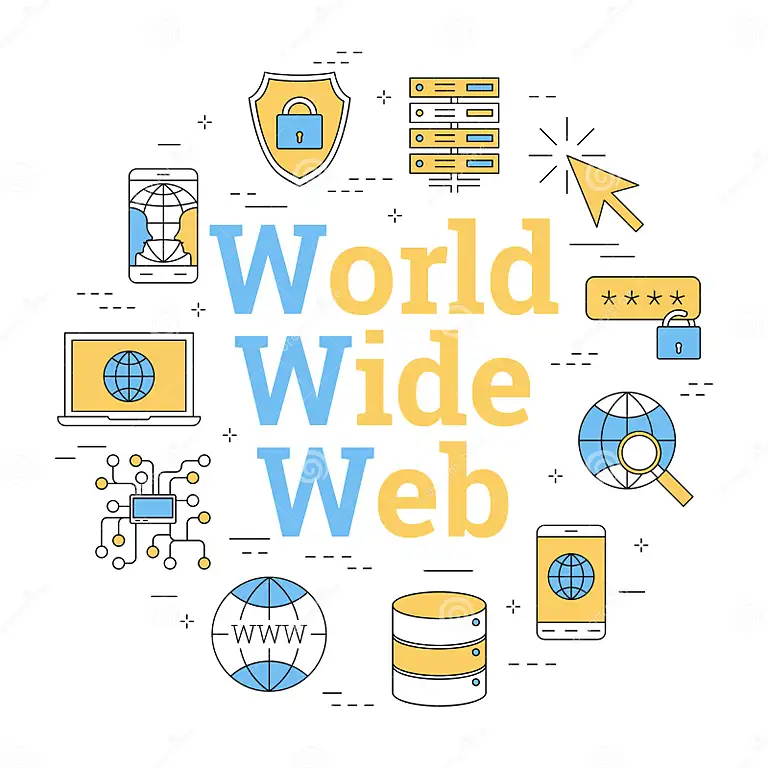
Das World Wide Web [ˌwɜːldˌwaɪdˈwɛb] ( Anhören?/i) (englisch für „weltweites Netz“, kurz Web oder WWW) ist ein über das Internet abrufbares System von elektronischen Hypertext-Dokumenten, sogenannten Webseiten, welche mit HTML beschrieben werden. Sie sind durch Hyperlinks untereinander verknüpft und werden im Internet über die Protokolle HTTP oder HTTPS übertragen. Die Webseiten enthalten meist Texte, oft mit Bildern und grafischen Elementen illustriert. Häufig sind auch Videos, Tondokumente oder Musikstücke eingebettet.
万维网(英语:World Wide Web)亦作WWW、Web、全球广域网,是一个透过互联网访问的,由许多互相链接的超文本组成的信息系统[1]。英国科学家蒂姆·伯纳斯-李于1989年发明了万维网。1990年他在瑞士CERN的工作期间编写了第一个网页浏览器[2][3]。网页浏览器于1991年1月向其他研究机构发行,并于同年8月向公众开放。
万维网是信息时代发展的核心,也是数十亿人在互联网上进行交互和浏览器的主要工具[4][5][6]。网页主要是文本文件格式化和超文本置标语言(HTML)。除了格式化文字之外,网页还可能包含图片、视频、声音和软件组件,这些组件会在用户的网页浏览器中呈现为多媒体内容的页面。
万维网并不等同互联网,万维网只是互联网所能提供的服务其中之一,是靠着互联网运行的一项服务。