Deutsch-Chinesische Enzyklopädie, 德汉百科
 China
China

 IT-Times


 Architektur
 Kunst
Kunst
 Museum

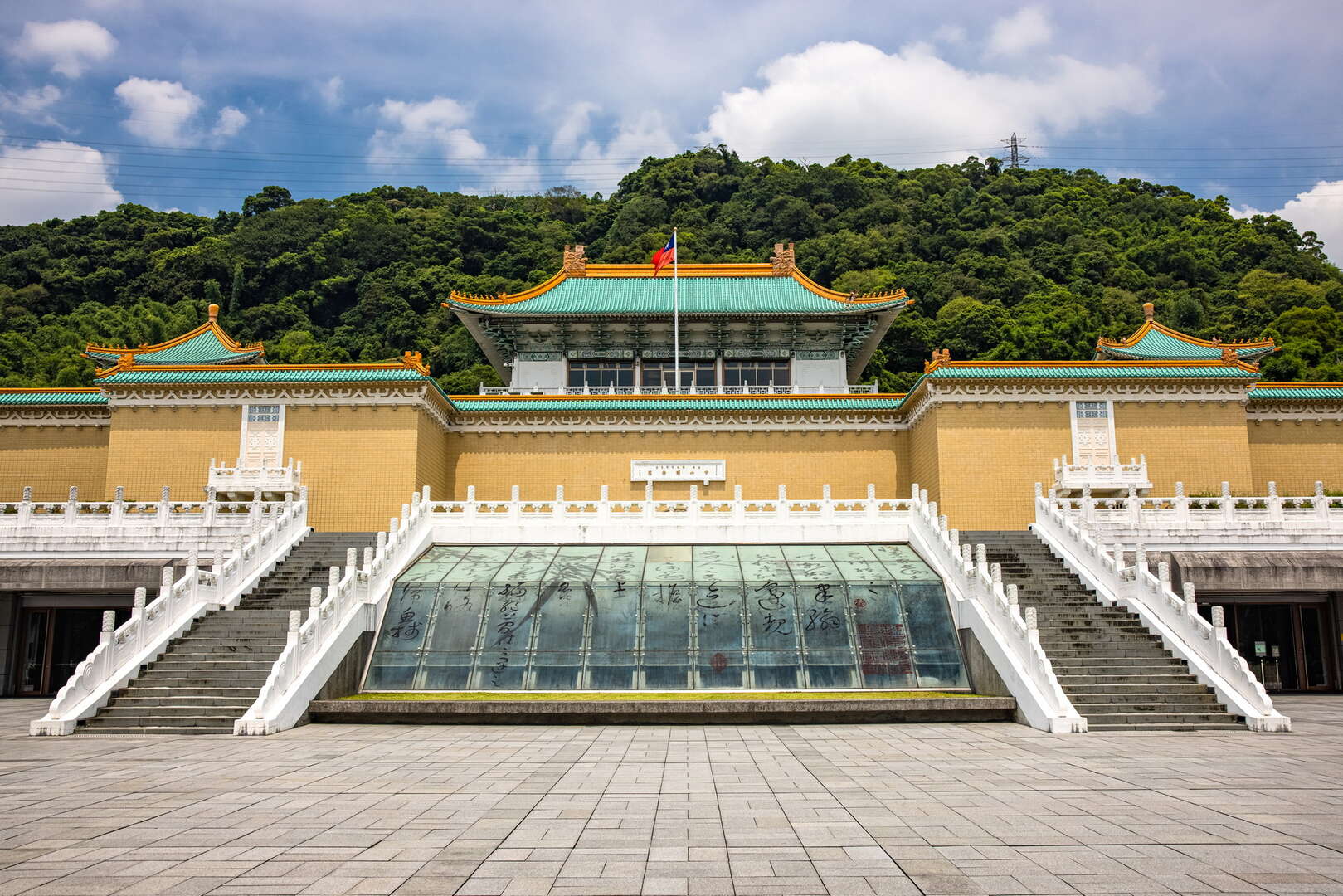

国立故宫博物院,简称故宫(博物院),俗称台湾故宫(博物院)或台北故宫(博物院)[i],别名中山博物院[j],为中华民国最具规模的博物馆以及台湾八景之一[13],也是古代中国艺术史与汉学研究机构。[12][14][15][16]馆舍坐落在台北市士林区至善路2段221号和台湾省嘉义县太保市故宫大道888号[6],一年可接待超过614万人次参访旅客,曾位列2015年全球参观人数第六多的艺术博物馆。[d]
国立故宫博物院是隶属于行政院的中央二级机关,故宫院长为特任官,视同部会首长。[1][4]它的前身是成立于京兆地方(今北京)紫禁城外廷的古物陈列所[17],1925年10月10日在紫禁城内廷另外组织了故宫博物院[7][18],后来因第二次中日战争爆发辗转迁移至南京和四川等地,古物陈列所则于第二次世界大战后裁撤并入国立中央博物院筹备处[k]。随后第二次国共内战的爆发再度导致时局动荡,1948年11月10日包括国立北平故宫博物院在内的六个机构于是决定携文物迁往台湾,几经改组易名,最终由国立北平故宫博物院和国立中央博物院合并为国立故宫博物院,1965年11月12日在台北现址复院开幕。[19][20]此后,博物馆历经多次馆舍扩建和修缮,并致力打造成为文化创意产业加值应用的虚拟博物馆,位于嘉义的南部院区也在2015年12月28日启用。[21]
国立故宫博物院物典藏近70万件册的艺术品和文物[9],大部分是原先国立北平故宫博物院、国立中央博物院筹备处和国立北平图书馆等机构所藏来自紫禁城、盛京行宫、避暑山庄、颐和园、静宜园和国子监等处皇家旧藏;另有部分是编列预算购置,接收自第二次世界大战结束日本归还文物,以及透过各界捐赠和征集而来。藏品时间跨度涵盖新石器时代至今长达8,000年[22],各类藏品分别交由器物处、书画处、图书文献处和南院处等4个策展部门管理,当中以长篇铭文的青铜器、古代早期的名家书画、善本古籍和官窑瓷器等搜藏最具影响力。[15][23][24][25][26]展厅内是按照文物类别以编年方式系统性地陈设4,000余件展品,器物类展件相隔半年至2年轮换一次,书画和图书文献类展件则每3个月定期更换[l]。[28][29]
Es beherbergt seit 1925 die weltweit größte Sammlung chinesischer Kunstwerke von unschätzbarem Wert, die die 8.000-jährige Geschichte Kontinentalostasiens umspannt. Die meisten der 697.490 Objekte waren ursprünglich Teil der kaiserlichen Kunstsammlung,[1] welche von Qing-Kaiser Qianlong zusammengetragen wurde. Die Exponate stammten aus der Verbotenen Stadt und wurden durch Chiang Kai-shek nach Taiwan gebracht, als dieser im Jahr 1949 vom Festland floh.[2] Nur die besten Stücke aus der kaiserlichen Sammlung werden hier bewahrt. Selbst so ist dieser Schatz noch bei weitem zu umfangreich, um auf einmal ausgestellt werden zu können. Viele der besonders geschätzten Stücke werden permanent gezeigt. Der Großteil der Sammlung von Jade, Porzellanwaren, Gemälden und Bronzen wird jedoch regelmäßig ausgetauscht.
Zu den bekanntesten Stücken aus der Sammlung des Palastmuseums zählen der Jadekohl (chinesisch 《翠玉白菜》, Pinyin Cuìyù Báicài) und der Fleischstein (chinesisch 《肉形石》, Pinyin Ròuxíngshí), beides detailgetreue Darstellungen von Nahrungsmitteln.[3]
国立故宮博物院(こくりつこきゅうはくぶついん)は、中華民国の台北市にある博物館である。この博物館は、中華民国の国立博物館のうちの1つであり、最大のもので、697,000個以上の古代の中国の人工品および美術品を所蔵している
故宮博物院は、1924年に北洋軍閥の一人である馮玉祥が溥儀を紫禁城から退去させ、1925年10月10日に宮殿内で清朝が持っていた美術品などを一般公開したのが始まりである。1925年当時の所蔵品点検レポートによると所蔵品総数は117万件を超えており、博物院は古物館、図書館、文献館を設けて各種文物の整理をする一方で、宮殿内に展示室を開設して多様な陳列を行っていた。
その後、満州に駐留していた日本軍が華北地方に軍を派遣してきたため、蒋介石の国民政府(1948年からは中華民国政府)は博物院の所蔵品を戦火や日本軍から守るべく重要文物を南方へ疎開させ、1933年2月から5月までの間に1万3,427箱と64包に及ぶ所蔵品がまず上海に運ばれ、その後1936年12月には南京市に故宮博物院南京分院保存庫に移動させた。その後1937年に日本軍が南京に向けて進軍してきたために、所蔵品は再び運び出されて80箱が四川省の巴県に、9,331箱が楽山に、約7,287箱が峨嵋の計3カ所に避難させられた[1]。
第二次世界大戦後、運び出された所蔵品は重慶を経て再び南京・北京に戻されたが、国共内戦が激化するにつれて中華民国政府の形勢が不利になったため、1948年の秋より中華民国政府は故宮博物院から第一級の所蔵品を精選し、第1陣として772箱の文物が、1949年1月には第2陣として3,502箱の文物が、同月に第3陣として1,251箱の文物が台湾に運び出された[1]。したがって故宮博物院の所蔵品は北京と台北の2カ所に別れて展示されている。これとは別に所蔵品の一部は、国共内戦後の中華人民共和国建国後の混乱のため北京に戻すことができず、現在も南京博物院の管轄下で南京に保管されている。
Le musée national du Palais (chinois : 國立故宮博物院 ; hanyu pinyin : Gúolì Gùgōng Bówùyùan), est un musée de Taipei, République de Chine (Taïwan), qui a recueilli les collections du palais impérial de la Cité interdite de Pékin.
Le musée national du Palais abrite quelque 697 490 pièces d'art chinois (fin décembre 2017), dont la plus grande collection d'objets artisanaux chinois du monde. Les collections comprennent des calligraphies, des peintures chinoises, des ouvrages anciens, des archives de la dynastie Qing, des bronzes, des jades, des céramiques et divers objets de collection. Il est considéré par la dimension de ses collections comme l'une des plus grandes institutions muséales du monde spécialisées dans l'art asiatique. Le musée national du Palais est distinct du musée du Palais qui se trouve dans la Cité interdite à Pékin. Ces deux établissements ont pourtant une origine commune car ils se partagent un même fonds de collections séparées par les aléas de la guerre civile chinoise.
Il National Palace Museum (cinese tradizionale: 國立故宮博物院; cinese semplificato: 国立故宫博物院; pinyin: Guólì Gùgōng Bówùyuàn) è un museo d'arte a Taipei, Taiwan. È il museo nazionale della Repubblica di Cina, e ha una collezione permanente di oltre 697.490 pezzi di antichi manufatti e opere d'arte cinese, che lo rende uno dei più grandi al mondo.
La collezione comprende oltre 8000 anni di storia cinese dall'età neolitica alla tarda dinastia Qing. Per la maggior parte è composta da pezzi di alta qualità raccolti da antichi imperatori della Cina. Nel 2008 è stato uno dei musei più visitati al mondo.
El Museo Nacional del Palacio es un museo de arte ubicado en la ciudad de Taipéi en Taiwán. Es el museo nacional de la República de China y alberga una colección permanente de más de 697.490 piezas y artesanías antiguas chinas, una de las más grandes del mundo.2 La mayor parte de su colección está compuesta por piezas de alta calidad reunidas por distintos emperadores chinos.
El Museo Nacional del Palacio no debe ser confundido con el Museo del Palacio (nótese la ausencia del término "nacional"), localizado en el interior de la Ciudad Prohibida en Pekín, capital de la República Popular de China. Ambas instituciones comparten las mismas raíces, que fueron divididas en dos como resultado de la Guerra civil china.3
Музей императорского дворца (кит. трад. 國立故宮博物院, упр. 国立故宫博物院, пиньинь: Guólì Gùgōng Bówùyùan, палл.: Голи Гугун Боуюань, буквально: «Национальный музей „Бывший императорский дворец“»; англ. National Palace Museum) — художественно-исторический музей в столице Китайской Республики (Тайваня), Тайбэе. В 2015 году находился на 6 месте в мире по посещаемости[1]. В литературе часто упоминается как музей «Гугун» (англ. Gugong), хотя это название применимо и к одноимённому музею в Пекине.
 Musik
Musik
 Darstellende Künste

国家大剧院占地11.893万平方米,总建筑面积149520平方米,主体建筑由外部围护结构和内部歌剧院、戏剧场、音乐厅和公共大厅及配套用房组成。国家大剧院共設有5473个座位,其中歌剧院席位2416个,戏剧院席位1040个,音乐厅席位2017个。外部围护钢结构壳体呈半椭球形,其平面投影东西长212.20米,南北宽143.64米,建筑物高46.285米,基础埋深的最深部分达到32.5米。椭球形屋面主要采用钛金属板饰面,中部为渐开式玻璃幕墙。椭球壳体外环绕人工湖,湖面面积达35500平方米,各种通道和入口都设在水面下。
国家大剧院结构由三个功能区组成。201区为北入口、地下车库;202区为功能区,包括歌剧院、戏剧院、音乐厅等;203为南入口、餐厅、机房等服务区。Das chinesische Nationale Zentrum für Darstellende Künste (chinesisch 國家大劇院 / 国家大剧院, Pinyin Guójiā dà jùyuàn; englisch National Grand Theatre), auch als Chinesisches Nationaltheater oder Chinesische Nationaloper bezeichnet, ist ein großes Theater- und Operngebäude in der chinesischen Hauptstadt Peking.
Es befindet sich in der Innenstadt westlich des Tian’anmen-Platzes und der Großen Halle des Volkes im Pekinger Stadtbezirk Xicheng.
Das von dem französischen Architekten Paul Andreu entworfene Gebäude wurde 2007 eröffnet. Es gilt durch seine eiförmige spektakuläre Außen- und Innenansicht – ellipsenförmig, aus Glas und Titan, an das traditionelle Yin-und-Yang-Motiv erinnernd, umgeben von einem künstlichen See – als eine der modernen architektonischen Sehenswürdigkeiten der Stadt.
Es ist eine Spielstätte für nationale und internationale Theater-, Opern-, Musik- und Tanzaufführungen.
中国国家大劇院(ちゅうごくこっかだいげきいん)は2007年9月に完成した中国北京の中心部に位置する国立劇場である。天安門広場の西側にあり人民大会堂にも隣接する。
2004年に着工。総工費は32億元。設計者はシャルル・ド・ゴール国際空港などを手がけたフランスの建築家ポール・アンドリュー[1]。外観では卵の形にしたドーム型の施設で、2,416席のオペラ劇場2,017席収容の音楽ホール、1,040席収容のコンサートホール等がある。
元々は1998年に当時の江沢民党総書記・国家主席が、国家大劇院を建設すると発表したことに始まり、2007年12月に正式にこけら落とされた。
こけら落とし公演はガラコンサートで、開場記念事業にはマリインスキー・オペラや、小澤征爾指揮中国国家交響楽団のジルベスターコンサートなどが2008年4月まで続けられた。
The National Centre for the Performing Arts (NCPA) (simplified Chinese: 国家大剧院; traditional Chinese: 國家大劇院; pinyin: Guójiā dà jùyuàn; literally: National Grand Theatre), and colloquially described as The Giant Egg (巨蛋), is an arts centre containing an opera house in Beijing, People's Republic of China. The Centre, an ellipsoid dome of titanium and glass surrounded by an artificial lake, seats 5,452 people in three halls and is almost 12,000 m² in size. It was designed by French architect Paul Andreu. Construction started in December 2001 and the inaugural concert was held in December 2007.
Le Centre national des arts du spectacle, précédemment appelé le Grand Théâtre national (en chinois 国家大剧院), est un bâtiment de Pékin comprenant dans 150 000 m2 une salle d’opéra de 2 416 places, une salle de concert de 2 017 places, et un théâtre de 1 040 places. Il est couramment appelé de manière un peu abusive l’opéra de Pékina, ou localement l’Œuf. Le bâtiment est situé sur l'avenue Chang'an (长安街), en plein centre historique de Pékin, face au parc de Zhongnanhai, immédiatement à l’ouest de la place Tian'anmen (dont il est séparé par le palais de l'Assemblée du Peuple) et au sud-ouest de la Cité interdite.
Cette construction qui a été inaugurée en décembre 2007 après six ans de travaux, a été conçu par l’architecte français Paul Andreu.
Elle consiste en un dôme de titane et de verre en forme d’ellipse, évoquant le motif traditionnel du yin et du yang, et entouré d’un lac artificiel qui lui donne l'impression de flotter sur l'eau. On accède à l'entrée principale qui se trouve au nord du bâtiment par l'intermédiaire d'une large esplanade inclinée permettant de pénétrer dans l'édifice en passant sous le lac.
Il Centro Nazionale per le Arti dello Spettacolo (国家大剧院S, Guójiā dà jùyuànP, letteralmente "Grande Teatro Nazionale"), noto come l'Opera di Pechino o, più familiarmente, L'uovo, è un teatro d'opera a Pechino, Repubblica Popolare Cinese.
Il Centro, una cupola ellissoidale di titanio e vetro circondata da un lago artificiale, comprende in un'area di oltre 200.000 m² una sala per l'opera di 2.416 posti, una sala concerti con 2.017 posti ed un teatro di 1.040 posti.
È stato progettato dall'architetto francese Paul Andreu. La costruzione è iniziata nel dicembre 2001 e il concerto inaugurale si è tenuto nel dicembre 2007. Il teatro è una cupola ellissoide in titanio, interrotta in direzione nord-sud da un rivestimento in vetro che si allarga gradualmente dall'alto verso il basso; si tratta di oltre 18.000 lamine di titanio ed oltre 1000 di vetro ad alta trasmissione luminosa. È stato progettato come qualcosa di emblematico che potesse essere immediatamente riconoscibile. La cupola misura 212 metri da est ad ovest, 144 da nord a sud ed è alta 46 metri. Gli ospiti giungono dal lato nord dopo aver camminato attraverso un corridoio lungo 80 metri passante al di sotto la superficie del lago.
El Gran Teatro Nacional de China, también conocido como «El Huevo», es un teatro de ópera en Pekín (República Popular China). Abrió sus puertas en junio de 2007. El arquitecto francés Paul Andreu fue el encargado de diseñarlo, con una planificación de coste inicial de unos 2.688 millones de yuanes. El teatro puede acoger hasta 6.500 personas en sus 200.000 m² de superficie.

中华人民共和国国庆节,有时也简称作国庆节、国庆,是为纪念中华人民共和国成立而设立的节日,庆祝日期被定为每年的10月1日[注 1][1]。1949年10月1日,中华人民共和国的开国大典在北京天安门广场举行,中华人民共和国中央人民政府正式成立。该节日在中国内地及其领土港澳被订为法定假日或者公众假期,法定的国庆假日在中国大陆为10月1日至10月3日共3天,但根据当年国庆节是星期几进行调休。一般会通过将其他周的周末休息调整到3天法定假的前后,来和该周的周末相连,从而形成7天的小长假。如遇中秋节等其他法定节假日则用连休8天假;在香港,法定假日在1997年和1998年时曾为2天,后改为1天;在澳门为2天。
中国人民政治协商会议第一届全国委员会第一次会议于1949年10月9日在中南海勤政殿举行,全国政协委员马叙伦因病委托委员许广平向会议提出“请政府明定10月1日为中华人民共和国国庆日,以代替10月10日的旧国庆日”的建议案,会议决定送请中央人民政府采择施行[注 2]。
国庆节期间会举行各种纪念活动,纪念中华人民共和国的革命先烈。自2008年起,每逢国庆节,党和国家领导人都会向位于天安门广场的人民英雄纪念碑敬献花篮。世界多地华侨社区,也会举办庆典、巡游或升旗仪式等活动庆祝。
National Day (Chinese: 国庆节; pinyin: guóqìng jié; lit. 'national celebration day'), officially the National Day of the People's Republic of China (中华人民共和国国庆节), is a public holiday in China celebrated annually on 1 October as the national day of the People's Republic of China, commemorating the formal proclamation of the establishment of the People's Republic of China on 1 October 1949. The Chinese Communist Party victory in the Chinese Civil War resulted in the Kuomintang retreat to Taiwan and the Chinese Communist Revolution whereby the People's Republic of China replaced the Republic of China.[2][3]Although it is observed on 1 October, another six days are added to the official holiday, normally in lieu of the two weekend breaks around 1 October, making it a de facto public holiday comprising seven consecutive days also known as Golden Week (黄金周; huángjīn zhōu) with specifics regulated by the State Council.[4] Festivities and concerts are usually held nationwide on this day, with a grand military parade and mass pageant event held on select years.[A] The parade held on 1 October 2019 marked the 70th anniversary of the People's Republic of China.

中华民国的国庆日[1][2],定为1911年武昌起义的发动日——10月10日。亦称双十节、双十国庆、双十庆典。武昌起义是辛亥革命的开端,起事后两个月内中国各地革命行动陆续成功,最终成功推翻清朝,并于1912年1月1日成立中华民国(中华民国开国纪念日),成为东亚第一个获普遍承认的民主国家。该日亦为中华民国的国定纪念日之一。
自从1949年中华民国政府迁台以来,每年皆举行庆典,在台北总统府前广场会举办升旗典礼以及国庆庆祝大会(全称“中华民国中枢暨各界庆祝国庆大会”),并有各式游行及表演队伍,在前中华民国总统蒋中正任内更是每年举行国庆阅兵;晚间则有中华民国国庆烟火施放表演。
The National Day of the Republic of China, also referred to as Double Ten Day or Double Tenth Day, is a public holiday on 10th of October, now held annually in Taiwan (officially the Republic of China, ROC). It was also celebrated during the ROC rule in mainland China before 1949, the date continues to be observed by the subsequent People's Republic of China (PRC) as the Anniversary of the Xinhai Revolution but not as a public holiday. It commemorates the start of the Wuchang Uprising on 10 October 1911 which ultimately led to the collapse of the imperial Qing dynasty and establishment of the Republic of China on 1 January 1912.[3]
Following the outcome of the Chinese Civil War, the ROC government lost control of mainland China to the Chinese Communist Party and retreated to the island of Taiwan in December 1949. The National Day is mainly celebrated in all ROC-controlled territories, but it is also celebrated by many overseas Chinese communities.
 Tierwelt

Das bereits vor 1,4 Milliarden entstandene Sanqing Shan Gebirge liegt mit einer Fläche von 229km2 im Nordosten von Nanchang. Witterung und Klima formten im Laufe der Zeit aus dem Granitmassiv einzigartige und außergewöhnliche Gebirgsstrukturen, teils bewaldet und bewachsen mit besonderen und seltenen Arten aus Flora und Fauna.
'Sanqing Shan ist ein berühmtes Gebirge des Daoismus. In daoistischen Werken wird es als einer der "72 glücklichen Orte" bezeichnet. In der östlichen Jin-Dynastie (317-420) praktizierte der daoistische Gelehrte Ge Hong (ca. 281-341) hier Selbstkultivierung und stellte Unsterblichkeitspillen her.
Von den Hauptgipfeln mit den Namen Yujing (1817m), Yuxu und Yuhua läßt sich eine atemberaubende Aussicht auf die in einem Wolkenmeer gelegenen Steinformen genießen.
2008 wurde das zum Nationalpark geschützte Sanqing Shan Gebirge von der UNESCO zum Weltnaturerbe ausgezeichnet. (Quelle:http://www.chinas-weltkulturerbe.de)
 Sport
*Nationale Spiele von China
Beijing Shi-BJ
Beijing Shi-BJ
Beijing Shi-BJ
Beijing Shi-BJ
Beijing Shi-BJ
China
Guangdong Sheng-GD
Guangdong Sheng-GD
Jiangsu Sheng-JS
Liaoning Sheng-LN
Shaanxi Sheng-SN
Shandong Sheng-SD
Shanghai Shi-SH
Shanghai Shi-SH
Tianjin Shi-TJ
Sport
*Nationale Spiele von China
Beijing Shi-BJ
Beijing Shi-BJ
Beijing Shi-BJ
Beijing Shi-BJ
Beijing Shi-BJ
China
Guangdong Sheng-GD
Guangdong Sheng-GD
Jiangsu Sheng-JS
Liaoning Sheng-LN
Shaanxi Sheng-SN
Shandong Sheng-SD
Shanghai Shi-SH
Shanghai Shi-SH
Tianjin Shi-TJ

Die Chinesischen Nationalspiele, später Nationalspiele der Volksrepublik China (chinesisch 中華人民共和國全國運動會 / 中华人民共和国全国运动会 Zhōnghuá Rénmín Gònghéguó Quánguó Yùndònghuì) sind eine Multisportveranstaltung in China. Sie sind nicht zu verwechseln mit den All-Chinesischen Spielen für nichtolympische Sportarten.

国家体育场,俗称“鸟巢”,位于中国北京市朝阳区奥林匹克公园内,占地面积20.4万平方米,于2003年12月动土,2004年3月正式开工,并于2008年6月28日完工。整个体育场由一系列辐射式门式钢桁架围绕碗状坐席区旋转而成,结构组件相互支撑,形成网格状的构架,外观如树枝编织成的鸟巢,场内观众坐席约为91,000个,其中临时坐席11,000个。国家体育场是北京市的标志性建筑,为2008年北京奥运会、2022年北京冬奥会的开闭幕式举办地,亦举办多项世界级及国家级文化体育盛事。
Das schweizer Architektenbüro Herzog und de Meuron entwarfen bereits schon die Allienz Arena in München und die neue Elbphilharmonie in Hamburg. Nun gibt es wieder ein neues aufsehen erregendes Projekt. Das Olympia Stadion in Beijing (China) wird für die Olympiade 2008 neu gebaut und soll bis zu 91.000 Zuschauern Platz bieten. Durch die löchrige Form der Außenhülle wird das Stadion auch liebevoll “Bird’s Nest” (Vogelnest) genannt.
Das Nationalstadion (chinesisch 國家體育場 / 国家体育场, Pinyin guójiā tǐyùchǎng – „Nationales Sportstadion“), umgangssprachlich auch Vogelnest genannt (鳥巢 / 鸟巢, niǎocháo, englisch Bird’s Nest), ist ein für die Olympischen Sommerspiele 2008 und die Sommer-Paralympics 2008 errichtetes Fußballstadion mit Leichtathletikanlage in der chinesischen Hauptstadt Peking. Es wurde von den Architekten Herzog & de Meuron als Teil des Olympic Green (Olympiapark) entworfen und am 28. Juni 2008 eröffnet. Bei den Olympischen Winterspielen 2022 ist das Nationalstadion der Ort der Eröffnungsfeier und der Schlussfeier.
China
 Geographie
Qinghai Sheng-QH
Geographie
Qinghai Sheng-QH
 Qinghai-Tibet-Eisenbahn
Xinjiang Uygur Zizhiqu-XJ
Xizang Zizhiqu-XZ
Qinghai-Tibet-Eisenbahn
Xinjiang Uygur Zizhiqu-XJ
Xizang Zizhiqu-XZ

 Transport und Verkehr
Beijing Shi-BJ
Belarus
Transport und Verkehr
Beijing Shi-BJ
Belarus
 Berlin
 Brandenburg
 Bremen
China
Deutschland
Frankreich
Gansu Sheng-GS
Bremen
China
Deutschland
Frankreich
Gansu Sheng-GS
 Hamburg
Hebei Sheng-HE
Heilongjiang Sheng-HL
Henan Sheng-HA
Hubei Sheng-HB
Hunan Sheng-HN
Iran
Italien
Jilin Sheng-JL
Kasachstan
Liaoning Sheng-LN
Nei Mongol Zizhiqu-NM
Niederlande
Hamburg
Hebei Sheng-HE
Heilongjiang Sheng-HL
Henan Sheng-HA
Hubei Sheng-HB
Hunan Sheng-HN
Iran
Italien
Jilin Sheng-JL
Kasachstan
Liaoning Sheng-LN
Nei Mongol Zizhiqu-NM
Niederlande
 Niedersachsen
Ningxia Huizu Zizhiqu-NX
Niedersachsen
Ningxia Huizu Zizhiqu-NX
 Nordrhein-Westfalen
Polen
Portugal
Russland
Nordrhein-Westfalen
Polen
Portugal
Russland
 Sachsen
 Schleswig-Holstein
Shaanxi Sheng-SN
Shandong Sheng-SD
Shanxi Sheng-SX
Sichuan Sheng-SC
Spanien
Türkei
Turkmenistan
Usbekistan
Vereinigtes Königreich
Xinjiang Uygur Zizhiqu-XJ
Zhejiang Sheng-ZJ
Schleswig-Holstein
Shaanxi Sheng-SN
Shandong Sheng-SD
Shanxi Sheng-SX
Sichuan Sheng-SC
Spanien
Türkei
Turkmenistan
Usbekistan
Vereinigtes Königreich
Xinjiang Uygur Zizhiqu-XJ
Zhejiang Sheng-ZJ
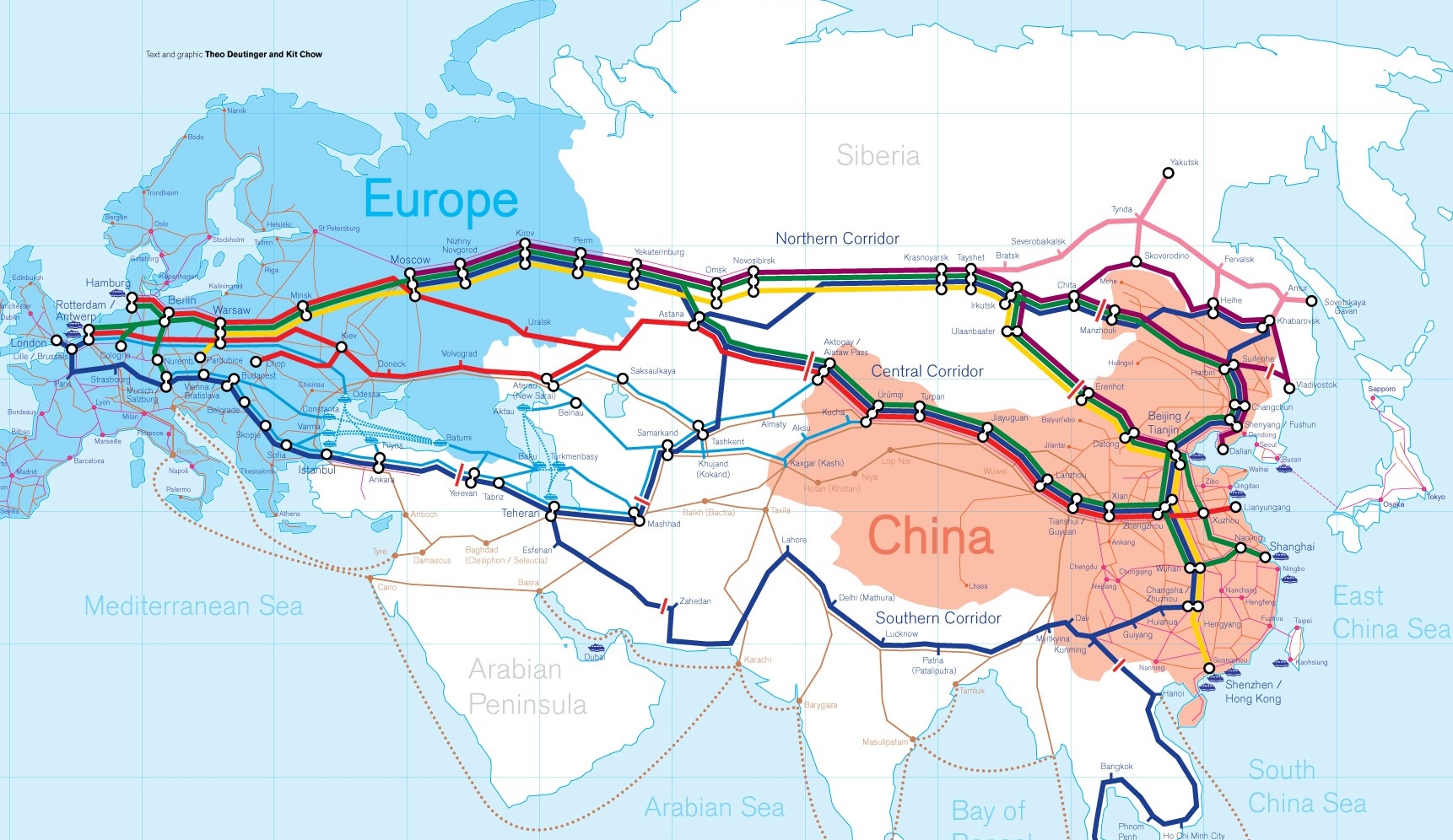
Die Neue eurasische Kontinentalbrücke (chinesisch 新亚欧大陆桥, Pinyin Xīn Yà-Ōu Dàlù Qiáo, englisch New Eurasian Continental Bridge), die auch Zweite eurasische Kontinentalbrücke (第二亚欧大陆桥, Dì'èr Yà-Ōu Dàlù Qiáo, englisch Second Eurasian Continental Bridge) genannt wird, ist eine 10.870 Kilometer[1] lange Eisenbahnverbindung, die Rotterdam in Europa mit der ostchinesischen Hafenstadt Lianyungang in der Provinz Jiangsu verbindet.
Sie besteht seit 1990 und führt durch die Dsungarische Pforte (Grenzbahnhof Alashankou). Die Lan-Xin-Bahn (chinesisch 兰新铁路, Pinyin Lán-Xīn Tiělù), also die Strecke von Lanzhou nach Ürümqi (in Xinjiang), ist ein Teil von ihr.
Es gibt eine nördliche, mittlere und südliche Route.[2] Die mittlere Strecke verläuft durch Kasachstan über Dostyk, Aqtogai, Astana, Samara, Smolensk, Brest, Warschau, Berlin zum Hafen von Rotterdam.[3] Vom slowakischen Košice soll auch eine Abzweigung in den Großraum Wien führen, siehe Breitspurstrecke Košice–Wien.
The New Eurasian Land Bridge, also called the Second or New Eurasian Continental Bridge, is the southern branch of the Eurasian Land Bridge rail links running through China. The Eurasian Land Bridge is the overland rail link between Asia and Europe.
Due to a break-of-gauge between standard gauge used in China and the Russian gauge used in the former Soviet Union countries, containers must be physically transferred from Chinese to Kazakh railway cars at Dostyk on the Chinese-Kazakh border and again at the Belarus-Poland border where the standard gauge used in western Europe begins. This is done with truck-mounted cranes.[1] Chinese media often states that the New Eurasian Land/Continental Bridge extends from Lianyungang to Rotterdam, a distance of 11,870 kilometres (7,380 mi). The exact route used to connect the two cities is not always specified in Chinese media reports, but appears to usually refer to the route which passes through Kazakhstan.
All rail freight from China across the Eurasian Land Bridge must pass north of the Caspian Sea through Russia at some point. A proposed alternative would pass through Turkey and Bulgaria,[2] but any route south of the Caspian Sea must pass through Iran.[1]
Kazakhstan's President Nursultan Nazarbayev urged Eurasian and Chinese leaders at the 18th Shanghai Cooperation Organisation to construct the Eurasian high-speed railway (EHSRW) following a Beijing-Astana-Moscow-Berlin.[3]
The Eurasian Land Bridge (Russian: Евразийский сухопутный мост, Yevraziyskiy sukhoputniy most), sometimes called the New Silk Road (Новый шёлковый путь, Noviy shyolkoviy put'), or Belt and Road Initiative is the rail transport route for moving freight and passengers overland between Pacific seaports in the Russian Far East and China and seaports in Europe. The route, a transcontinental railroad and rail land bridge, currently comprises the Trans-Siberian Railway, which runs through Russia and is sometimes called the Northern East-West Corridor, and the New Eurasian Land Bridge or Second Eurasian Continental Bridge, running through China and Kazakhstan. As of November 2007, about 1% of the $600 billion in goods shipped from Asia to Europe each year were delivered by inland transport routes.[1]
Completed in 1916, the Trans-Siberian connects Moscow with Russian Pacific seaports such as Vladivostok. From the 1960s until the early 1990s the railway served as the primary land bridge between Asia and Europe, until several factors caused the use of the railway for transcontinental freight to dwindle. One factor is that the railways of the former Soviet Union use a wider rail gauge than most of the rest of Europe as well as China. Recently, however, the Trans-Siberian has regained ground as a viable land route between the two continents.[why?]
China's rail system had long linked to the Trans-Siberian via northeastern China and Mongolia. In 1990 China added a link between its rail system and the Trans-Siberian via Kazakhstan. China calls its uninterrupted rail link between the port city of Lianyungang and Kazakhstan the New Eurasian Land Bridge or Second Eurasian Continental Bridge. In addition to Kazakhstan, the railways connect with other countries in Central Asia and the Middle East, including Iran. With the October 2013 completion of the rail link across the Bosphorus under the Marmaray project the New Eurasian Land Bridge now theoretically connects to Europe via Central and South Asia.
Proposed expansion of the Eurasian Land Bridge includes construction of a railway across Kazakhstan that is the same gauge as Chinese railways, rail links to India, Burma, Thailand, Malaysia and elsewhere in Southeast Asia, construction of a rail tunnel and highway bridge across the Bering Strait to connect the Trans-Siberian to the North American rail system, and construction of a rail tunnel between South Korea and Japan. The United Nations has proposed further expansion of the Eurasian Land Bridge, including the Trans-Asian Railway project.
El Nuevo Puente de Tierra de Eurasia es también llamado el Segundo o Nuevo Puente Continental de Eurasia. Es la rama meridional de las conexiones ferroviarias del Puente de Tierra de Eurasia (también conocido como "Nueva Ruta de la Seda") que se extienden a través de la República Popular China, atravesando Kazajistán, Rusia y Bielorrusia. El Puente de Tierra de Eurasia es el enlace ferroviario terrestre entre Asia Oriental y Europa.
La Nueva Ruta de la Seda (en ruso, Новый шёлковый путь, Noviy shyolkoviy put), o Puente Terrestre Euroasiático, es la ruta de transporte ferroviario para el movimiento de tren de mercancías y tren de pasajeros por tierra entre los puertos del Pacífico, en el Lejano Oriente ruso y chino y los puertos marítimos en Europa.
La ruta, un ferrocarril transcontinental y puente terrestre, actualmente comprende el ferrocarril Transiberiano, que se extiende a través de Rusia, y el nuevo puente de tierra de Eurasia o segundo puente continental de Eurasia, que discurre a través de China y Kazajistán, también se van a construir carreteras entre las ciudades de la ruta. A partir de noviembre de 2007, aproximadamente el 1% de los 600 millones de dólares en bienes enviados desde Asia a Europa cada año se entregaron por vías de transporte terrestre.1
Terminado en 1916, el tren Transiberiano conecta Moscú con el lejano puerto de Vladivostok en el océano Pacífico, el más largo del mundo en el Lejano Oriente e importante puerto del Pacífico. Desde la década de 1960 hasta principios de 1990 el ferrocarril sirvió como el principal puente terrestre entre Asia y Europa, hasta que varios factores hicieron que el uso de la vía férrea transcontinental para el transporte de carga disminuyese.
Un factor es que los ferrocarriles de la Unión Soviética utilizan un ancho de vía más ancho en los rieles que la mayor parte del resto de Europa y China, y el transporte en barcos de carga por el canal de Suez en Egipto, construido por Inglaterra. El sistema ferroviario de China se une al Transiberiano en el noreste de China y Mongolia. En 1990 China añadió un enlace entre su sistema ferroviario y el Transiberiano a través de Kazajistán. China denomina a su enlace ferroviario ininterrumpido entre la ciudad portuaria de Lianyungang y Kazajistán como el «Puente terrestre de Nueva Eurasia» o «Segundo puente continental Euroasiático». Además de Kazajistán, los ferrocarriles conectan con otros países de Asia Central y Oriente Medio, incluyendo a Irán. Con la finalización en octubre de 2013 de la línea ferroviaria a través del Bósforo en el marco del proyecto Marmaray el puente de tierra de Nueva Eurasia conecta ahora teóricamente a Europa a través de Asia Central y del Sur.
La propuesta de ampliación del Puente Terrestre Euroasiático incluye la construcción de un ferrocarril a través de Kazajistán con el mismo ancho de vía que los ferrocarriles chinos, enlaces ferroviarios a la India, Birmania, Tailandia, Malasia y otros países del sudeste asiático, la construcción de un túnel ferroviario y un puente de carretera a través del estrecho de Bering para conectar el Transiberiano al sistema ferroviario de América del Norte, y la construcción de un túnel ferroviario entre Corea del Sur y Japón. Las Naciones Unidas ha propuesto una mayor expansión del Puente Terrestre Euroasiático, incluyendo el proyecto del ferrocarril transasiático.
Новый шёлковый путь (Евразийский сухопутный мост — концепция новой паневразийской (в перспективе — межконтинентальной) транспортной системы, продвигаемой Китаем, в сотрудничестве с Казахстаном, Россией и другими странами, для перемещения грузов и пассажиров по суше из Китая в страны Европы. Транспортный маршрут включает трансконтинентальную железную дорогу — Транссибирскую магистраль, которая проходит через Россию и второй Евразийский континентальный мост[en], проходящий через Казахстан[1]. Поезда по этому самому длинному в мире грузовому железнодорожному маршруту из Китая в Германию будут идти 15 дней, что в 2 раза быстрее, чем по морскому маршруту через Суэцкий канал[2].
Идея Нового шёлкового пути основывается на историческом примере древнего Великого шёлкового пути, действовавшего со II в. до н. э. и бывшего одним из важнейших торговых маршрутов в древности и в средние века. Современный НШП является важнейшей частью стратегии развития Китая в современном мире — Новый шёлковый путь не только должен выстроить самые удобные и быстрые транзитные маршруты через центр Евразии, но и усилить экономическое развитие внутренних регионов Китая и соседних стран, а также создать новые рынки для китайских товаров (по состоянию на ноябрь 2007 года, около 1 % от товаров на 600 млрд долл. из Азии в Европу ежегодно доставлялись наземным транспортом[3]).
Китай продвигает проект «Нового шёлкового пути» не просто как возрождение древнего Шёлкового пути, транспортного маршрута между Востоком и Западом, но как масштабное преобразование всей торгово-экономической модели Евразии, и в первую очередь — Центральной и Средней Азии. Китайцы называют эту концепцию — «один пояс — один путь». Она включает в себя множество инфраструктурных проектов, которые должны в итоге опоясать всю планету. Проект всемирной системы транспортных коридоров соединяет Австралию и Индонезию, всю Центральную и Восточную Азию, Ближний Восток, Европу, Африку и через Латинскую Америку выходит к США. Среди проектов в рамках НШП планируются железные дороги и шоссе, морские и воздушные пути, трубопроводы и линии электропередач, и вся сопутствующая инфраструктура. По самым скромным оценкам, НШП втянет в свою орбиту 4,4 миллиарда человек — более половины населения Земли[4].
Предполагаемое расширение Евразийского сухопутного моста включает в себя строительство железнодорожных путей от трансконтинентальных линий в Иран, Индию, Мьянму, Таиланд, Пакистан, Непал, Афганистан и Малайзию, в другие регионы Юго-Восточной Азии и Закавказья (Азербайджан, Грузия). Маршрут включает тоннель Мармарай под проливом Босфор, паромные переправы через Каспийское море (Азербайджан-Иран-Туркменистан-Казахстан) и коридор Север-Юг.Организация Объединенных Наций предложила дальнейшее расширение Евразийского сухопутного моста, в том числе проекта Трансазиатской железной дороги (фактически существует уже в 2 вариантах).
Для развития инфраструктурных проектов в странах вдоль Нового шёлкового пути и Морского Шёлкового пути и с целью содействия сбыту китайской продукции в декабре 2014 года был создан инвестиционный Фонд Шёлкового пути[5].
8 мая 2015 года было подписано совместное заявление Президента РФ В. Путина и Председателя КНР Си Цзиньпина о сотрудничестве России и Китая, в рамках ЕАЭС и трансевразийского торгово-инфраструктурного проекта экономического пояса «Шёлковый путь». 13 июня 2015 года был запущен самый длинный в мире грузовой железнодорожный маршрут Харбин — Гамбург (Германия), через территорию России.