
Deutsch-Chinesische Enzyklopädie, 德汉百科
 England
 Architektur
 Kunst
Kunst
 Audi Cup
England
Audi Cup
England
 Manchester
FIFA-Klub-Weltmeisterschaft 2025
FIFA-Klub-Weltmeisterschaft 2025
Gruppe G
Pep Guardiola
Premier League
Premier League 2015/16
Premier League 2016/17
Premier League 2017/18
Premier League 2018/19
Sepp Herberger
UEFA Champions League 2015/16
UEFA Champions League 2016/17
Gruppe C
UEFA Champions League 2017/18
Gruppe F
UEFA Champions League 2018/19
Gruppe F
UEFA Champions League 2019/20
Gruppe C
UEFA Champions League 2025/26
Manchester
FIFA-Klub-Weltmeisterschaft 2025
FIFA-Klub-Weltmeisterschaft 2025
Gruppe G
Pep Guardiola
Premier League
Premier League 2015/16
Premier League 2016/17
Premier League 2017/18
Premier League 2018/19
Sepp Herberger
UEFA Champions League 2015/16
UEFA Champions League 2016/17
Gruppe C
UEFA Champions League 2017/18
Gruppe F
UEFA Champions League 2018/19
Gruppe F
UEFA Champions League 2019/20
Gruppe C
UEFA Champions League 2025/26




 Transport und Verkehr

 Musik
Musik


 Alex Ferguson
Audi Cup
England
Manchester
José Mourinho
Louis van Gaal
Premier League
Premier League 2015/16
Premier League 2016/17
Premier League 2017/18
Premier League 2018/19
Alex Ferguson
Audi Cup
England
Manchester
José Mourinho
Louis van Gaal
Premier League
Premier League 2015/16
Premier League 2016/17
Premier League 2017/18
Premier League 2018/19
 Sport
(F)UEFA Europa League
UEFA Champions League 2015/16
UEFA Champions League 2017/18
Gruppe A
UEFA Champions League 2018/19
Gruppe H
UEFA Europa League 2019/20
Gruppe L
Vereinigtes Königreich
Sport
(F)UEFA Europa League
UEFA Champions League 2015/16
UEFA Champions League 2017/18
Gruppe A
UEFA Champions League 2018/19
Gruppe H
UEFA Europa League 2019/20
Gruppe L
Vereinigtes Königreich

 Internationale Städte
England
England
Manchester
Internationale Städte
England
England
Manchester
 Geschichte
ITU World Championship Series
Sport
Triathlon
Vereinigtes Königreich
Geschichte
ITU World Championship Series
Sport
Triathlon
Vereinigtes Königreich
 Von den Römern gegründete Städte
 Wichtiger Hafen
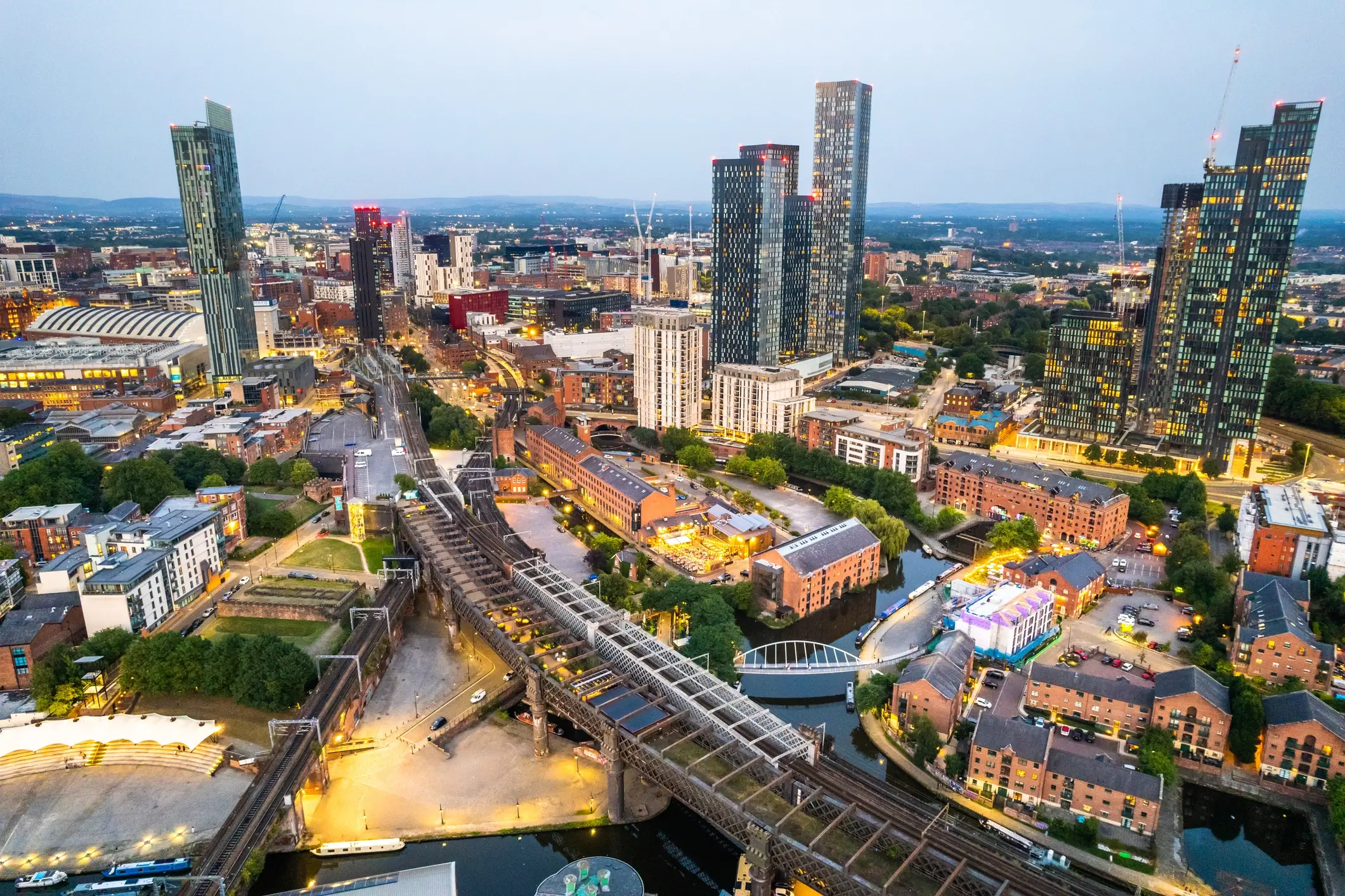
Manchester ([ˈmɛntʃɛstɐ], englisch [ˈmæntʃɪstə])[1] ist eine Stadt im Nordwesten von England im Vereinigten Königreich Großbritannien und Nordirland mit dem Status eines Metropolitan Borough sowie einer City. Sie hat etwa 570.000 Einwohner und liegt im Metropolitan County Greater Manchester, einer der größten Agglomerationen in England mit 2,9 Mio. Einwohnern (2022). Die Einwohner Manchesters werden „Mancunians“ oder verkürzt „Mancs“ genannt.
Die Ursprünge der Stadt Manchester gehen auf ein römisches Kastell am Zusammenfluss der Flüsse Irwell und Medlock zurück. Vor allem im Zeitalter der Industriellen Revolution wurde Manchester zu einem wichtigen Standort der Industrie. Einen besonderen Stellenwert nahm dabei die Textilindustrie ein, deren Anfänge in Manchester auf das Spätmittelalter zurückgehen. Im 20. Jahrhundert erfolgte der stetige Zerfall der Industrie. Heute ist Manchester dennoch eines der wichtigsten Wirtschaftszentren des Vereinigten Königreichs und beherbergt zahlreiche Museen, Hochschulen und Orte der Kunst und Kultur.
曼彻斯特市(英语:City of Manchester),即曼彻斯特(英语:Manchester),是英格兰的城市,都市自治市,位于西北英格兰区域,人口约为55万人,是曼彻斯特都市圈中人口最多的城市,且是英格兰西北第一多,英国第五多的城市。
曼彻斯特在工业革命史中有着重要位置。十八世纪,资本主义在这座城市萌芽,让本是农村地区的曼彻斯特经历急速发展并成为全世界第一座工业化的城市。全世界第一条城际通勤铁路在此诞生。因市内兴盛的纺织业,曼彻斯特在工业革命期间曾因仓库众多而闻名于世,使其获得了“仓库城市”的别称。曼彻斯特在科学技术史上也占有重要位置。成立于2002年的曼彻斯特大学及其前身见证了原子核物理学的诞生,世界上第一台存储程式电脑以及石墨烯的发现。
曼彻斯特被誉为“北方之都”[2][3],是英格兰北部一个极其重要的城市,尤其是在其经济、艺术、文化、交通运输、媒体和体育地位上。步入二十一世纪,曼彻斯特的发展愈发强势,为这座城市带来了与伯明翰竞争英国第二大城市的地位的资本[4]。
1974年,曼彻斯特与周围市镇联合组成大曼彻斯特郡,成为该郡的一个都会区。“曼彻斯特”此名常用来指整个都市区。整个大曼彻斯特的市区总人口在英国排名第二,仅次于伦敦。
マンチェスター (Manchester, IPA: [ˈmænˌtʃɪstə][ヘルプ/ファイル]) は、イングランドの北西部、グレーター・マンチェスターに位置する都市。北部イングランドを代表する都市であり、イギリスで9番目の都市である。1853年に市制(英語版)が布かれ、2011年の時点で、マンチェスター(都市と都市バラ)の人口は49万人である。2011年の近郊を含む都市圏人口は224万人であり、同国第3位である[2]。
Manchester (/ˈmæntʃɪstər, -tʃɛs-/)[5][6] is a city and metropolitan borough in Greater Manchester, England, with a population of 545,500 as of 2017.[7] It lies within the United Kingdom's third-most populous metropolitan area, with a population of 3.2 million.[8] Manchester is fringed by the Cheshire Plain to the south, the Pennines to the north and east, and an arc of towns with which it forms a continuous conurbation. The local authority is Manchester City Council.
The recorded history of Manchester began with the civilian settlement associated with the Roman fort of Mamucium or Mancunium, which was established in about AD 79 on a sandstone bluff near the confluence of the rivers Medlock and Irwell. It was historically a part of Lancashire, although areas of Cheshire south of the River Mersey were incorporated in the 20th century.[9] Throughout the Middle Ages Manchester remained a manorial township but began to expand "at an astonishing rate" around the turn of the 19th century. Manchester's unplanned urbanisation was brought on by a boom in textile manufacture during the Industrial Revolution,[10] and resulted in it becoming the world's first industrialised city.[11]
Manchester achieved city status in 1853. The Manchester Ship Canal opened in 1894, creating the Port of Manchester and directly linking the city to the Irish Sea, 36 miles (58 km) to the west. Its fortune declined after the Second World War, owing to deindustrialisation, but the IRA bombing in 1996 led to extensive investment and regeneration.[12]
In 2014, the Globalization and World Cities Research Network ranked Manchester as a beta world city, the highest-ranked British city apart from London.[13] Manchester is the third-most visited city in the UK, after London and Edinburgh.[14] It is notable for its architecture, culture, musical exports, media links, scientific and engineering output, social impact, sports clubs and transport connections. Manchester Liverpool Road railway station was the world's first inter-city passenger railway station; scientists first split the atom, developed the stored-program computer and produced graphene in the city. Manchester hosted the 2002 Commonwealth Games.
Manchester Ecoutez (ˈmanˌtʃɪstə) est une ville du Royaume-Uni située dans le comté métropolitain du Grand Manchester. Elle a le statut de cité depuis 1853 et compte 545 500 habitants en 2017. Elle est parfois considérée comme la « deuxième ville d’Angleterre » grâce à son importance économique, culturelle et sportive1, bien que sa superficie et sa population ne lui permettent pas de détrôner Birmingham. Manchester est catégorisée comme une ville « bêta » par Le GaWC (Réseau d’étude sur la mondialisation et les villes mondiales2). Ses habitants s'appellent les Mancunien(ne)s. La ville est au cœur d'une grande agglomération de plus de deux millions et demi d'habitants dont les villes principales sont : Bury, Bolton, Rochdale, Oldham, Ashton-under-Lyne, Stockport, Salford, Altrincham, Wigan. Le nom de « Manchester » est utilisé aussi bien pour désigner l'agglomération que la ville en tant que telle.
Manchester est située à 260 km au nord-ouest de Londres, sur la rive est de la rivière Irwell. La ville est bordée au Sud par la plaine du Cheshire et au Nord et à l'Est par la chaîne montagneuse des Pennines. Historiquement, la majeure partie de la ville faisait partie du Lancashire, mais des zones situées au sud de la rivière Mersey appartenaient au Cheshire. Le vicus créé par les Romains à proximité du fort de Mamucium, construit en 79 sur un monticule rocheux non loin de la confluence entre la Medlock et l'Irwell, est devenu au fil de son histoire une ville majeure du nord de l'Angleterre. Manchester est la première ville au monde à avoir été industrialisée, et elle a joué un rôle important durant la révolution industrielle. Durant le XIXe siècle, la ville acquiert d'ailleurs le surnom de « Cottonopolis » en raison de son importante industrie cotonnière. L'économie de la ville s'est depuis tournée vers le secteur tertiaire, et il s'agit aujourd'hui d'un pôle financier important.
Manchester est une ville importante culturellement, qui héberge de nombreux théâtres, musées et salles de concert. La ville a vu dans les années 1980 l'émergence de divers groupes de rock indépendant autour du club The Haçienda, qui deviendront très célèbres par la suite et que l'on regroupe sous l'appellation « Madchester ». Elle a une économie nocturne bien développée avec de nombreux bars et clubs. La ville est le siège de divers médias, dont de nombreuses stations de radios, des journaux et une importante base de la BBC. L'architecture de la ville est marquée par l'omniprésence des briques rouges. Elle mêle des bâtiments historiques, comme la cathédrale gothique, des édifices de l'époque victorienne et de la période industrielle, avec des bâtiments à l'architecture contemporaine, dont de hauts gratte-ciel. Manchester est la troisième ville la plus visitée par les étrangers au Royaume-Uni.
Manchester est également une importante ville étudiante avec ses deux universités, l'université de Manchester et l'université métropolitaine de Manchester qui, avec entre-autres le Royal Northern College of Music, regroupent plus de 70 000 étudiants.
La ville accueillit en 2002 les jeux du Commonwealth. Elle se démarque également dans le monde sportif par ses deux équipes de Premier League de football, Manchester United et Manchester City.
Manchester (AFI: /ˈmanʧester/[3]; in inglese [ˈmantʃɪstə][4]), in italiano antico Mancunia, è un borgo metropolitano di 503.127 abitanti del Regno Unito, che gode del titolo onorifico di città, ed è capoluogo della contea metropolitana inglese della Greater Manchester. Insediamento celtico poi rinominata dagli antichi romani magna castra, i suoi abitanti vengono chiamati Mancunians (Mancuniani).
Mánchester1 (pronunciado en inglés  /ˈmæntʃɛstə/ (?·i)) es una ciudad y un municipio metropolitano del condado de Gran Mánchester en Inglaterra. Mánchester obtuvo su estatus de ciudad en 1853 y tenía una población estimada de 530.300 habitantes en 2015.2 A su vez, forma parte de la segunda aglomeración urbana del Reino Unido y decimocuarta de la Unión Europea en términos de población.
Mánchester es un importante centro artístico, financiero, de medios de comunicación y de educación superior. En una encuesta de líderes empresariales británicos publicada en 2006, Mánchester era considerada como el mejor lugar en el Reino Unido para establecer un negocio. Un informe encargado por la Asociación de Mánchester, publicado en 2007, mostró a Mánchester como la "ciudad con más rápido crecimiento económico". Es la tercera ciudad más visitada en el Reino Unido por turistas extranjeros. Mánchester fue la anfitriona de los Juegos de la Mancomunidad de 2002, y es sede de dos equipos de fútbol de la Premier League, Manchester United y Manchester City.
Históricamente la mayor parte de la ciudad fue parte del condado de Lancashire, con las zonas ubicadas al sur del río Mersey en el condado de Cheshire. Mánchester fue la primera ciudad industrializada del mundo y desempeñó un papel central durante la Revolución industrial. Se convirtió en el principal centro internacional de la fabricación textil y de hilado de algodón. Durante el siglo XIX adquirió el apodo de "Cottonopolis", sugiriendo que era una metrópoli de las fábricas de algodón. El centro de la ciudad se encuentra en una lista provisional del Patrimonio de la Humanidad de la Unesco, debido principalmente a la red de canales y molinos construidos durante los siglos XVIII y XIX.
Манче́стер[2] (англ. Manchester ['mænʧɪstə]) — город и метрополитенский район в Северо-Западной Англии, графство Большой Манчестер. Менее чем полумиллионный город имеет крупнейшую в регионе 2,2-миллионную агломерацию Большой Манчестер. Девятый по величине город Великобритании (и восьмой — Англии).
Наряду с Бирмингемом, Лидсом, Шеффилдом, Ливерпулем и Лондоном Манчестер был одним из центров Промышленной революции. В настоящее время Манчестер — крупный культурный, промышленный, финансовый, коммерческий и транспортный центр страны. Развито машиностроение, текстильная, химическая, лёгкая, бумажная промышленность. Действует морской порт. Манчестерский университет является одним из самых престижных в Великобритании. Имеется городской музей и художественная галерея[3].

 Militär,Verteidigung und Ausrüstung

德文港海军基地(Her Majesty's Naval Base, Devonport;HMNB Devonport)是英国皇家海军的三个现有的海军基地之一,坐落于英格兰德文郡普利茅斯的德文港。它是西欧最大的海军基地[1]。1934年至21世纪初,海军基地也以“HMS Drake”的名义知名。这里驻扎着德文港海军舰队,其中包括特拉法尔加级潜艇。它是三个海军基地中唯一负责核设施维修和燃料补充的基地。
Die Marinebasis Devonport (offiziell His Majesty’s Naval Base Devonport) ist ein Flottenstützpunkt der britischen Royal Navy. Sie befindet sich im englischen Plymouth am Hamoaze und ist die größte Marinebasis Westeuropas.
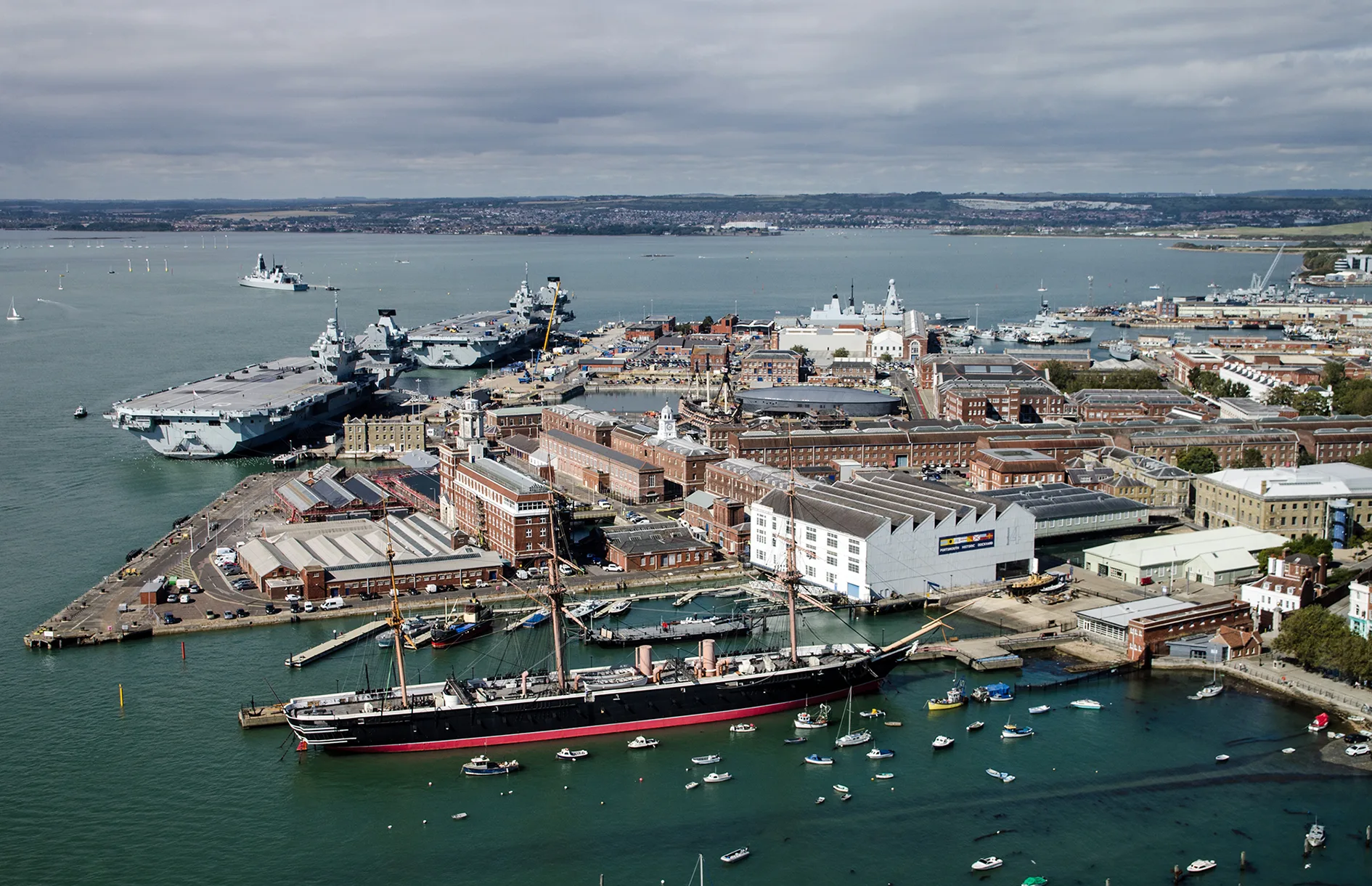
Die Marinebasis Portsmouth (offiziell His Majesty’s Naval Base Portsmouth) ist der größte Stützpunkt der britischen Royal Navy. Sie befindet sich im Westen der Stadt Portsmouth in Hampshire auf der Halbinsel Portsea Island. Britische Seeleute bezeichnen sowohl die Stadt als auch die Marinebasis mit dem Spitznamen Pompey. Der Ursprung des Spitznamens soll in der ursprünglich französischen Bezeichnung für Feuerwehr Pompiers liegen.
朴次茅夫海军基地(HMNB Portsmouth)为英国皇家海军三个现役海军基地之一,另外两个分别为位于苏格兰的克莱德海军基地与位于英格兰西南部的德文港海军基地。朴次茅夫海军基地建于朴次茅夫港的东岸,威特岛以北,皇家海军近三分之二的水面舰艇长期停泊于此基地。基地内设有英国海军总指挥部,舰只维修设备与及供乘务员使用的设施如宿舍及医疗,全部均由英国国防部提供。
朴次茅夫海军基地为皇家海军最古老的海军基地,近几个世纪中于大英帝国扩张时期与及保卫英伦三岛上扮演着不可或缺的角色。基地内亦有旅游景点胜利号(HMS Victory)与及战士号(HMS Warrior)。于2006年英国国防部表示将重新检讨三个现役军港的未来发展,以确保能提供皇家海军的需要。估计三个海军港都将会保留,惟亦有可能会缩减每个基地的设备甚至关闭英格兰两个军港中的其中一个。