Deutsch-Chinesische Enzyklopädie, 德汉百科
 Italy
Italy

 Military, defense and equipment
 Mitglieder der NATO
 NATO summit
 Campania
 Neapel
Eurovision Song Contest,ESC
FIFA Fussball-Weltmeisterschaft 1990
Neapel
Eurovision Song Contest,ESC
FIFA Fussball-Weltmeisterschaft 1990
 History
 International cities
Italy
International cities
Italy
 World Heritage
 Important port

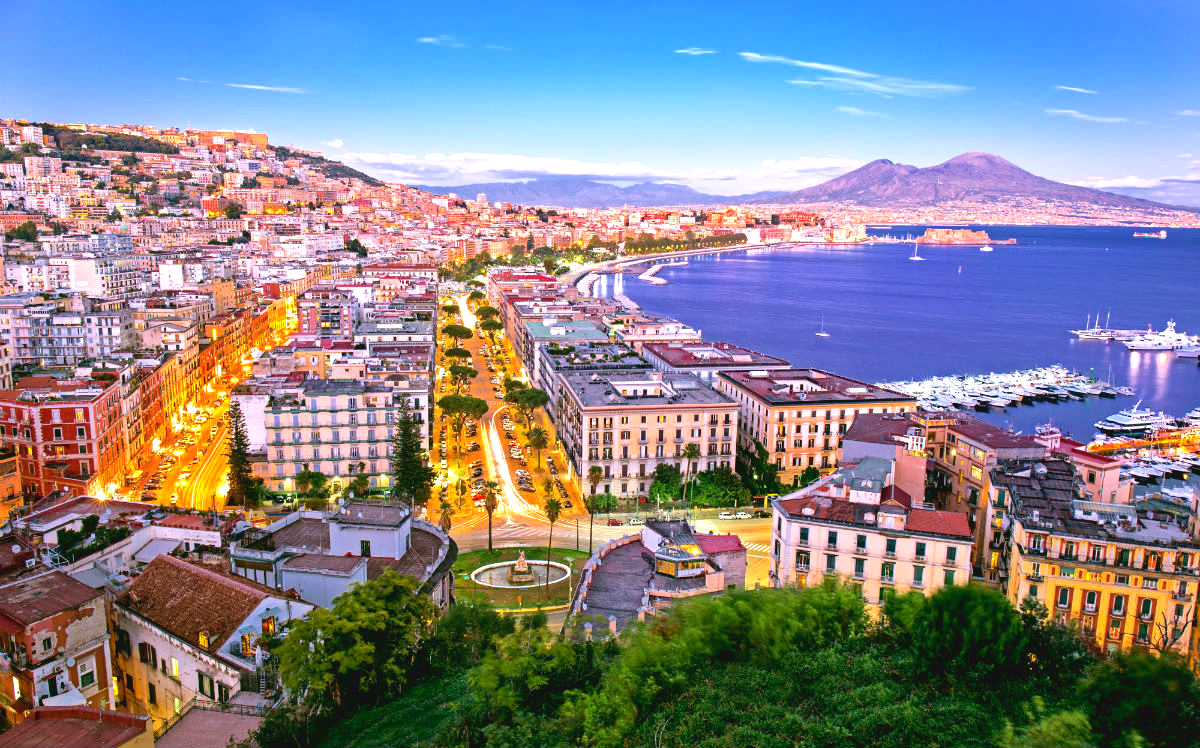
那不勒斯(意大利语:Napoli;那不勒斯语:Nàpule)是意大利南部的第一大城市,坎帕尼亚大区以及那不勒斯省的首府。城市面积117平方公里,人口略低于100万。那不勒斯都会区有大约380万人口,是仅次于米兰和罗马的意大利第三大都会区[3]和欧洲第15大都会区[3]。那不勒斯地区也是意大利人口最稠密的地方之一。
那不勒斯位于那不勒斯湾的北岸,其东西两侧分别是两个火山区域:维苏威火山和坎皮佛莱格瑞火山区。因此,该市自古至今不断受到火山活动和地震的威胁。
那不勒斯始于前600年[4],以其丰富的历史、文化、艺术和美食而著称,那不勒斯历史中心被联合国教科文组织列为世界文化遗产。比萨饼起源于那不勒斯。音乐是那不勒斯文化中产生了广泛影响的的一个重要组成部分,包括发明了浪漫吉他和曼陀林,以及对歌剧和拿波里民谣的重大贡献。
Neapel (Italienisch Napoli, Neapolitanisch Napule, altgriechisch: Νεάπολις („neue Stadt“)) ist mit knapp einer Million Einwohnern die drittgrößte Stadt Italiens. Die Hauptstadt der Region Kampanien sowie der Metropolitanstadt Neapel ist ein wirtschaftliches und kulturelles Zentrum Süditaliens. Die Metropolregion hat bis zu 4,4 Millionen Einwohner. Viele Neapolitaner sprechen das stark vom Standarditalienischen abweichende Neapolitanisch.
Die ursprüngliche griechische Siedlung trug den Namen Neapolis („Neustadt“). Später geriet sie unter römische Herrschaft. Vom Spätmittelalter bis zum 18. Jahrhundert gehörte Neapel zu den größten Städten Europas. Seine politische Geschichte ist über weite Strecken von Fremdherrschaft geprägt, zudem war es die Hauptstadt süditalienischer Reiche.
ナポリ(伊: Napoli ( 音声ファイル) ; ナポリ語: Napule)は、イタリア南部にある都市で、その周辺地域を含む人口約98万人の基礎自治体(コムーネ)。カンパニア州の州都であり、ナポリ県の県都でもある。ローマ、ミラノに次ぐイタリア第三の都市で、南イタリア最大の都市である。都市圏人口は約300万人。
ナポリ湾に面した港湾都市・工業都市である[4]。古代ギリシア人によって建設された植民市に起源を持ち、13世紀以降はナポリ王国の首都として南イタリアの政治・経済の中心地となった[4]。ヴェスヴィオ火山を背景とする風光明媚な景観[4]で知られる観光都市であり、「ナポリを見てから死ね (vedi Napoli e poi muori)」[注釈 1]と謳われる[4]。旧市街地は「ナポリ歴史地区」として世界遺産に登録されている。ナポリ周辺にも、ヴェスヴィオ火山やポンペイの遺跡、カプリ島などの観光地を有する。
Naples (/ˈneɪpəlz/; Italian: Napoli [ˈnaːpoli ] ( listen), Neapolitan: Napule [ˈnɑːpələ] or [ˈnɑːpulə]; Latin: Neapolis; Ancient Greek: Νεάπολις, lit. 'new city') is the regional capital of Campania and the third-largest municipality in Italy after Rome and Milan. In 2017, around 967,069 people lived within the city's administrative limits while its province-level municipality has a population of 3,115,320 residents. Its continuously built-up metropolitan area (that stretches beyond the boundaries of the Metropolitan City of Naples) is the second or third largest metropolitan area in Italy.
First settled by Greeks in the second millennium BC, Naples is one of the oldest continuously inhabited urban areas in the world.[3] In the ninth century BC, a colony known as Parthenope or Παρθενόπη was established on the Island of Megaride,[4] later refounded as Neápolis in the sixth century BC.[5] The city was an important part of Magna Graecia, played a major role in the merging of Greek and Roman society and a significant cultural centre under the Romans.[6] It was capital of the Duchy of Naples (661-1139), then the Kingdom of Naples (1282 and 1816) and finally the Two Sicilies until the unification of Italy in 1861.
Between 1925 and 1936, Naples was expanded and upgraded by Benito Mussolini's government but severely damaged by Allied bombing during World War II, leading to extensive post-1945 reconstruction work.[7] Naples has experienced significant economic growth in recent decades, helped by the construction of the Centro Direzionale business district and an advanced transportation network, which includes the Alta Velocità high-speed rail link to Rome and Salerno and an expanded subway network. Naples is the third-largest urban economy in Italy, after Milan and Rome[8]. The Port of Naples is one of the most important in Europe and home of the Allied Joint Force Command Naples, the NATO body that oversees North Africa, the Sahel and Middle East.[9]
Naples' historic city centre is the largest in Europe and a UNESCO World Heritage Site, with a wide range of culturally and historically significant sites nearby, including the Palace of Caserta and the Roman ruins of Pompeii and Herculaneum. Naples is also known for its natural beauties such as Posillipo, Phlegraean Fields, Nisida, and Vesuvius.[10]
Neapolitan cuisine is synonymous with pizza, which originated in the city but it includes many other less well-known dishes and is the Italian city with the highest number of accredited stars from the Michelin Guide.[11]
The best known sports team in Naples is the Serie A club S.S.C. Napoli, two-time Italian champions who play at the San Paolo Stadium in the southwest of the city.
Naples (en italien Napoli /ˈnapoli/, en napolitain Napule) est une ville d'Italie, capitale de la région de Campanie. Elle est la troisième ville d'Italie par sa population et la dix-huitième de l'Union européenne ainsi que respectivement la deuxième (devant Rome) et la neuvième en incluant sa banlieue2. C'est aussi la deuxième plus grande cité méditerranéenne en Europe, après Barcelone.
L'histoire de Naples s'étend sur plus de vingt-huit siècles. Sous le nom de Parthénope, elle fut fondée durant l'Antiquité par la cité voisine de Cumes. Elle s'étend ensuite rapidement jusqu'à devenir un des principaux centres commerciaux, culturels, philosophiques et politiques de la Grande-Grèce puis de l'Empire romain. Après avoir été brièvement dépendante de l'Empire byzantin, elle devient autonome au sein du duché de Naples. Dès le XIIIe siècle et pour ensuite plus de 600 ans, elle devient la capitale du Royaume de Naples puis successivement du Royaume des Deux-Siciles. Elle reste alors un des principaux centres de développement économiques et technologiques d'Europe jusqu'à son annexion au Royaume d’Italie en 1860, date à laquelle elle entame un relatif déclin socio-économique.
Au cours des siècles, Naples a aussi été un des grands centres universitaires internationaux. L'Université de Naples «Frédéric-II» est la plus ancienne université laïque du monde et la 6e plus ancienne en général. Elle compte également l'Université de Naples «L'Orientale», un des plus anciens instituts de langues orientales, ainsi que l'École militaire Nunziatella, une des plus renommées d'Italie. Elle est aussi un des hauts-lieux de la musique (avec l'école napolitaine de musique, à l'origine de l'Opéra bouffe, ou la chanson napolitaine), de l'art et de l'architecture (le Baroque napolitain, l'École du Pausilippe, le Liberty napolitain, le Théâtre napolitain et la Manufacture de Capodimonte) ou encore la cuisine napolitaine (avec les pâtes et surtout la pizza napolitaine comme icône, Naples étant la ville italienne la plus étoilée au Guide Michelin3).
La ville est aussi célèbre pour son patrimoine et ses monuments. Le centre historique de Naples (avec ses fontaines, vestiges antiques, palais et plus de 1 000 églises) est ainsi le plus grand centre-ville inscrit au patrimoine mondial de l'UNESCO tandis que le parc national du Vésuve et le Miglio d'oro ont été reconnus réserve de biosphère. De plus, Naples est connue pour ses nombreuses beautés naturelles (Posillipo, Champs Phlégréens, Nisida, Vésuve, etc.), comparables à ceux de Rio de Janeiro4.
Enfin, elle abrite également la Villa Rosebery (l'une des trois résidences officielles du président de la République italienne), le siège d'un commandement interalliés et interarmées de l'OTAN, la Apple Developer Academy ainsi qu'un vaste patrimoine archéologique avec notamment la Naples souterraine ou, à proximité, la ville d'Herculanum, une ancienne banlieue5.
Napoli (AFI: /ˈnapoli/[4] ; Nàpule in napoletano, pronuncia [ˈnɑːpulə] o [ˈnɑːpələ]) è un comune italiano di 964 004 abitanti[2], capoluogo dell'omonima città metropolitana e della regione Campania.
Terzo comune in Italia per popolazione, Napoli è tra le più popolose e densamente popolate aree metropolitane dell'Unione europea.[N 1]
Fondata dai Cumani nell'VIII secolo a.C., fu tra le città più importanti della Magna Græcia[5][6], grazie al rapporto privilegiato con Atene[7], ed esercitò una notevole influenza commerciale, culturale e religiosa sulle popolazioni italiche circostanti[8] tanto da diventare sede della scuola epicurea di Filodemo di Gadara e Sirone. Dopo il crollo dell'Impero romano, nell'VIII secolo la città formò un ducato autonomo indipendente dall'Impero bizantino; in seguito, dal XIII secolo e per circa seicento anni, fu capitale del Regno di Napoli; con la Restaurazione divenne capitale del Regno delle Due Sicilie sotto i Borbone fino all'Unità d'Italia. Per motivi culturali, politici, storici e sociali è stata, dall'evo antico sino ai giorni nostri, una delle città cardine dell'Occidente.[9]
Sede della Federico II, la più antica università statale d'Europa,[10] ospita altresì l'Orientale, la più antica università di studi sinologici ed orientalistici del continente[11] e la Nunziatella, una delle più antiche accademie militari al mondo, eletta patrimonio storico e culturale dei Paesi del Mediterraneo da parte dell'Assemblea parlamentare del Mediterraneo.[12] Luogo d'origine della lingua napoletana, ha esercitato ed esercita un forte ruolo in numerosi campi del sapere, della cultura e dell'immaginario collettivo a livello nazionale ed internazionale.
Centro della filosofia naturalistica del rinascimento[13] e centro illuminista di livello europeo[14], è stata a lungo un punto di riferimento globale per la musica classica e l'opera attraverso la scuola musicale napoletana[15], dando tra l'altro origine all'opera buffa.[16]
Città dall'imponente tradizione nel campo delle arti figurative, che affonda le proprie radici nell'età classica, ha dato luogo a movimenti architettonici e pittorici originali, quali il rinascimento napoletano[17] e il barocco napoletano,[18] il caravaggismo,[19] la scuola di Posillipo[20] ed il Liberty napoletano,[21] nonché ad arti minori ma di rilevanza internazionale, quali la porcellana di Capodimonte[22] ed il presepe napoletano.[23]
È all'origine di una forma distintiva di teatro,[24] di una canzone di fama mondiale[25] e di una peculiare tradizione culinaria[26] che comprende alimenti che assumono il ruolo di icone globali, come la pizza napoletana,[27] e l'arte dei suoi pizzaioli che è stata dichiarata dall'UNESCO patrimonio immateriale dell'umanità.[28]
Nel 1995 il centro storico di Napoli è stato riconosciuto dall'UNESCO come patrimonio mondiale dell'umanità, per i suoi eccezionali monumenti, che testimoniano la successione di culture del Mediterraneo e dell'Europa[29]. Nel 1997 l'apparato vulcanico Somma-Vesuvio è stato eletto dalla stessa agenzia internazionale (con il vicino Miglio d'Oro, in cui ricadono anche i quartieri orientali della città) tra le riserve mondiali della biosfera.[30]
Nápoles (en italiano Napoli, en napolitano Napule) es la ciudad más poblada del sur de Italia, capital de la región de Campania y de la Ciudad metropolitana de Nápoles de más de 6 millones de habitantes. La ciudad de Nápoles administrativa tiene algo menos de un millón de habitantes,2 que, unidos a los de su área metropolitana, se elevan a 3,7 millones. Sus habitantes reciben el gentilicio de napolitanos. Está situada a medio camino entre el monte Vesubio y otra área volcánica, los Campos Flégreos. Da nombre al Golfo de Nápoles.
Tiene una gran riqueza histórica, artística, cultural y gastronómica, lo que llevó a la Unesco a declarar su centro histórico Patrimonio de la Humanidad.3 Griegos, romanos, bizantinos, normandos, franceses y españoles han dejado su huella en Nápoles. Estuvo brevemente bajo dominación austríaca en las primeras décadas del siglo XVIII, tras la cual se convirtió en el centro político del reino independiente de Nápoles y, posteriormente, de las Dos Sicilias, gobernado por los Borbones. En el año 1861 pasó a formar parte del Reino de Italia. En el siglo XX, durante el fascismo y en la reconstrucción subsiguiente a la Segunda Guerra Mundial se edificó gran parte de la periferia. En las últimas décadas, Nápoles se ha dotado de un distrito financiero con rascacielos (CDN) e infraestructuras como el TAV, hacia Roma y Salerno, o una red de metro en proceso de expansión. Por otra parte, también le acucian grandes problemas como el crimen organizado, muy presente en la vida de una parte de sus habitantes y que constituye un freno al desarrollo económico y social; o de otra naturaleza, las fuerzas telúricas: la ciudad ha sufrido grandes terremotos y la actividad volcánica es vigilada constantemente.
Неа́поль (др.-греч. Νεάπολις, от др.-греч. νέα πόλις букв. — новый город; лат. Neapolis, итал. Napoli, неап. Napule) — город в Италии. Административный центр области Кампания и провинции Неаполь. Расположен в бухте Неаполитанского залива.
Неаполь — третий по величине город Италии (после Рима и Милана) и самый большой город Южной Италии с населением около миллиона человек (с пригородами — около трёх миллионов). Крупный транспортный узел (международный аэропорт, морской порт). Наряду с официальным итальянским языком в просторечии местных жителей распространён неаполитанский диалект. Святой покровитель города — св. Януарий, день памяти которого 19 сентября отмечается как праздник города.
Находится в сейсмоопасной зоне (историческая часть — на западном склоне Везувия). Последнее извержение Везувия произошло в 1944 году. Последнее катастрофическое землетрясение случилось в Неаполе в 1980 году.
 Transport and traffic
Beijing Shi-BJ
Belarus
Transport and traffic
Beijing Shi-BJ
Belarus
 Berlin
 Brandenburg
 Bremen
China
Germany
France
Gansu Sheng-GS
Bremen
China
Germany
France
Gansu Sheng-GS
 Hamburg
Hebei Sheng-HE
Heilongjiang Sheng-HL
Henan Sheng-HA
Hubei Sheng-HB
Hunan Sheng-HN
Iran
Italy
Jilin Sheng-JL
Kasachstan
Liaoning Sheng-LN
Nei Mongol Zizhiqu-NM
Netherlands
Hamburg
Hebei Sheng-HE
Heilongjiang Sheng-HL
Henan Sheng-HA
Hubei Sheng-HB
Hunan Sheng-HN
Iran
Italy
Jilin Sheng-JL
Kasachstan
Liaoning Sheng-LN
Nei Mongol Zizhiqu-NM
Netherlands
 Lower Saxony
Ningxia Huizu Zizhiqu-NX
Lower Saxony
Ningxia Huizu Zizhiqu-NX
 North Rhine-Westphalia
Poland
Portugal
Russia
North Rhine-Westphalia
Poland
Portugal
Russia
 Saxony
 Schleswig-Holstein
Shaanxi Sheng-SN
Shandong Sheng-SD
Shanxi Sheng-SX
Sichuan Sheng-SC
Spain
Turkey
Turkmenistan
Uzbekistan
United Kingdom
Xinjiang Uygur Zizhiqu-XJ
Zhejiang Sheng-ZJ
Schleswig-Holstein
Shaanxi Sheng-SN
Shandong Sheng-SD
Shanxi Sheng-SX
Sichuan Sheng-SC
Spain
Turkey
Turkmenistan
Uzbekistan
United Kingdom
Xinjiang Uygur Zizhiqu-XJ
Zhejiang Sheng-ZJ
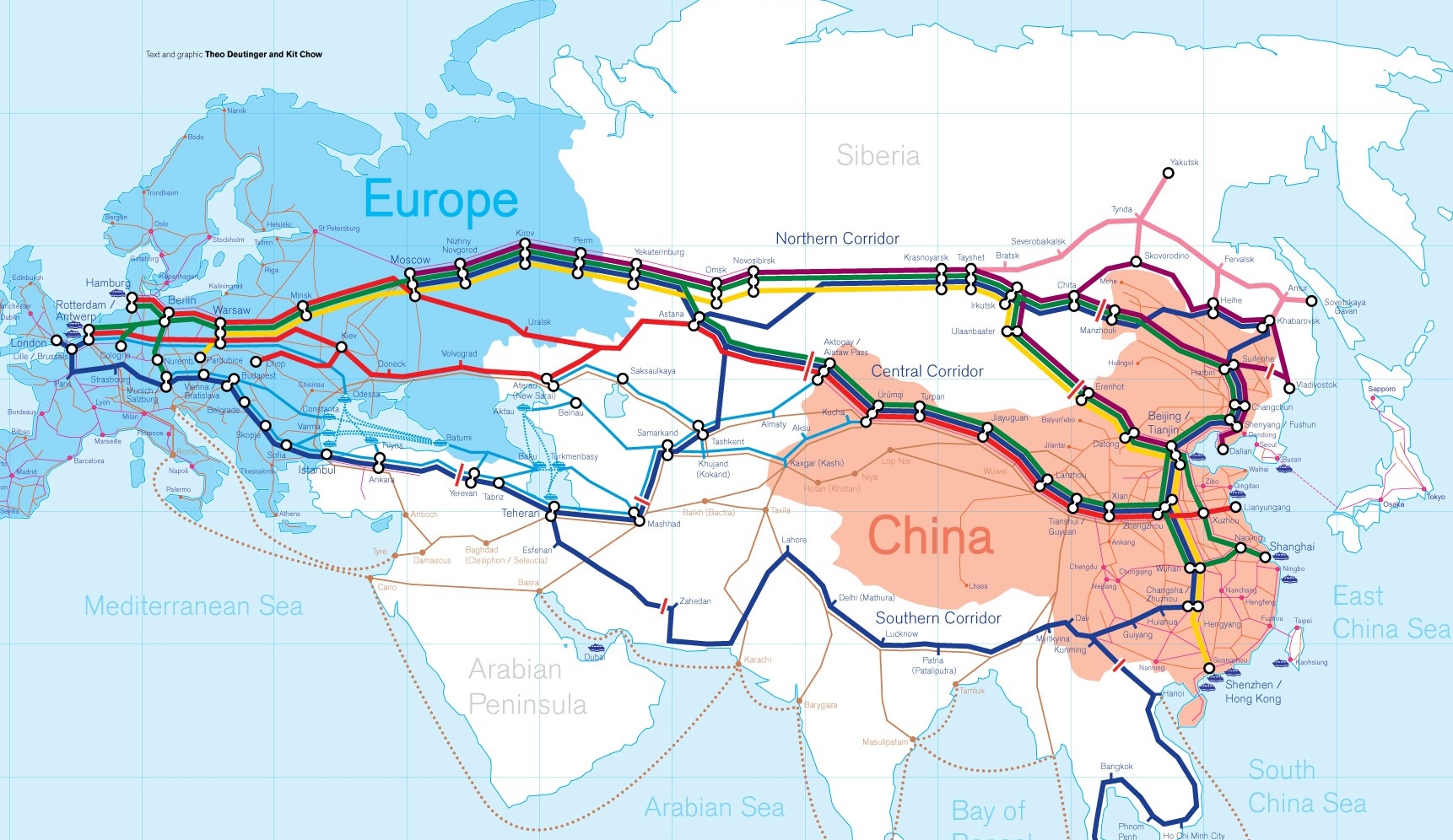
Die Neue eurasische Kontinentalbrücke (chinesisch 新亚欧大陆桥, Pinyin Xīn Yà-Ōu Dàlù Qiáo, englisch New Eurasian Continental Bridge), die auch Zweite eurasische Kontinentalbrücke (第二亚欧大陆桥, Dì'èr Yà-Ōu Dàlù Qiáo, englisch Second Eurasian Continental Bridge) genannt wird, ist eine 10.870 Kilometer[1] lange Eisenbahnverbindung, die Rotterdam in Europa mit der ostchinesischen Hafenstadt Lianyungang in der Provinz Jiangsu verbindet.
Sie besteht seit 1990 und führt durch die Dsungarische Pforte (Grenzbahnhof Alashankou). Die Lan-Xin-Bahn (chinesisch 兰新铁路, Pinyin Lán-Xīn Tiělù), also die Strecke von Lanzhou nach Ürümqi (in Xinjiang), ist ein Teil von ihr.
Es gibt eine nördliche, mittlere und südliche Route.[2] Die mittlere Strecke verläuft durch Kasachstan über Dostyk, Aqtogai, Astana, Samara, Smolensk, Brest, Warschau, Berlin zum Hafen von Rotterdam.[3] Vom slowakischen Košice soll auch eine Abzweigung in den Großraum Wien führen, siehe Breitspurstrecke Košice–Wien.
The New Eurasian Land Bridge, also called the Second or New Eurasian Continental Bridge, is the southern branch of the Eurasian Land Bridge rail links running through China. The Eurasian Land Bridge is the overland rail link between Asia and Europe.
Due to a break-of-gauge between standard gauge used in China and the Russian gauge used in the former Soviet Union countries, containers must be physically transferred from Chinese to Kazakh railway cars at Dostyk on the Chinese-Kazakh border and again at the Belarus-Poland border where the standard gauge used in western Europe begins. This is done with truck-mounted cranes.[1] Chinese media often states that the New Eurasian Land/Continental Bridge extends from Lianyungang to Rotterdam, a distance of 11,870 kilometres (7,380 mi). The exact route used to connect the two cities is not always specified in Chinese media reports, but appears to usually refer to the route which passes through Kazakhstan.
All rail freight from China across the Eurasian Land Bridge must pass north of the Caspian Sea through Russia at some point. A proposed alternative would pass through Turkey and Bulgaria,[2] but any route south of the Caspian Sea must pass through Iran.[1]
Kazakhstan's President Nursultan Nazarbayev urged Eurasian and Chinese leaders at the 18th Shanghai Cooperation Organisation to construct the Eurasian high-speed railway (EHSRW) following a Beijing-Astana-Moscow-Berlin.[3]
The Eurasian Land Bridge (Russian: Евразийский сухопутный мост, Yevraziyskiy sukhoputniy most), sometimes called the New Silk Road (Новый шёлковый путь, Noviy shyolkoviy put'), or Belt and Road Initiative is the rail transport route for moving freight and passengers overland between Pacific seaports in the Russian Far East and China and seaports in Europe. The route, a transcontinental railroad and rail land bridge, currently comprises the Trans-Siberian Railway, which runs through Russia and is sometimes called the Northern East-West Corridor, and the New Eurasian Land Bridge or Second Eurasian Continental Bridge, running through China and Kazakhstan. As of November 2007, about 1% of the $600 billion in goods shipped from Asia to Europe each year were delivered by inland transport routes.[1]
Completed in 1916, the Trans-Siberian connects Moscow with Russian Pacific seaports such as Vladivostok. From the 1960s until the early 1990s the railway served as the primary land bridge between Asia and Europe, until several factors caused the use of the railway for transcontinental freight to dwindle. One factor is that the railways of the former Soviet Union use a wider rail gauge than most of the rest of Europe as well as China. Recently, however, the Trans-Siberian has regained ground as a viable land route between the two continents.[why?]
China's rail system had long linked to the Trans-Siberian via northeastern China and Mongolia. In 1990 China added a link between its rail system and the Trans-Siberian via Kazakhstan. China calls its uninterrupted rail link between the port city of Lianyungang and Kazakhstan the New Eurasian Land Bridge or Second Eurasian Continental Bridge. In addition to Kazakhstan, the railways connect with other countries in Central Asia and the Middle East, including Iran. With the October 2013 completion of the rail link across the Bosphorus under the Marmaray project the New Eurasian Land Bridge now theoretically connects to Europe via Central and South Asia.
Proposed expansion of the Eurasian Land Bridge includes construction of a railway across Kazakhstan that is the same gauge as Chinese railways, rail links to India, Burma, Thailand, Malaysia and elsewhere in Southeast Asia, construction of a rail tunnel and highway bridge across the Bering Strait to connect the Trans-Siberian to the North American rail system, and construction of a rail tunnel between South Korea and Japan. The United Nations has proposed further expansion of the Eurasian Land Bridge, including the Trans-Asian Railway project.
El Nuevo Puente de Tierra de Eurasia es también llamado el Segundo o Nuevo Puente Continental de Eurasia. Es la rama meridional de las conexiones ferroviarias del Puente de Tierra de Eurasia (también conocido como "Nueva Ruta de la Seda") que se extienden a través de la República Popular China, atravesando Kazajistán, Rusia y Bielorrusia. El Puente de Tierra de Eurasia es el enlace ferroviario terrestre entre Asia Oriental y Europa.
La Nueva Ruta de la Seda (en ruso, Новый шёлковый путь, Noviy shyolkoviy put), o Puente Terrestre Euroasiático, es la ruta de transporte ferroviario para el movimiento de tren de mercancías y tren de pasajeros por tierra entre los puertos del Pacífico, en el Lejano Oriente ruso y chino y los puertos marítimos en Europa.
La ruta, un ferrocarril transcontinental y puente terrestre, actualmente comprende el ferrocarril Transiberiano, que se extiende a través de Rusia, y el nuevo puente de tierra de Eurasia o segundo puente continental de Eurasia, que discurre a través de China y Kazajistán, también se van a construir carreteras entre las ciudades de la ruta. A partir de noviembre de 2007, aproximadamente el 1% de los 600 millones de dólares en bienes enviados desde Asia a Europa cada año se entregaron por vías de transporte terrestre.1
Terminado en 1916, el tren Transiberiano conecta Moscú con el lejano puerto de Vladivostok en el océano Pacífico, el más largo del mundo en el Lejano Oriente e importante puerto del Pacífico. Desde la década de 1960 hasta principios de 1990 el ferrocarril sirvió como el principal puente terrestre entre Asia y Europa, hasta que varios factores hicieron que el uso de la vía férrea transcontinental para el transporte de carga disminuyese.
Un factor es que los ferrocarriles de la Unión Soviética utilizan un ancho de vía más ancho en los rieles que la mayor parte del resto de Europa y China, y el transporte en barcos de carga por el canal de Suez en Egipto, construido por Inglaterra. El sistema ferroviario de China se une al Transiberiano en el noreste de China y Mongolia. En 1990 China añadió un enlace entre su sistema ferroviario y el Transiberiano a través de Kazajistán. China denomina a su enlace ferroviario ininterrumpido entre la ciudad portuaria de Lianyungang y Kazajistán como el «Puente terrestre de Nueva Eurasia» o «Segundo puente continental Euroasiático». Además de Kazajistán, los ferrocarriles conectan con otros países de Asia Central y Oriente Medio, incluyendo a Irán. Con la finalización en octubre de 2013 de la línea ferroviaria a través del Bósforo en el marco del proyecto Marmaray el puente de tierra de Nueva Eurasia conecta ahora teóricamente a Europa a través de Asia Central y del Sur.
La propuesta de ampliación del Puente Terrestre Euroasiático incluye la construcción de un ferrocarril a través de Kazajistán con el mismo ancho de vía que los ferrocarriles chinos, enlaces ferroviarios a la India, Birmania, Tailandia, Malasia y otros países del sudeste asiático, la construcción de un túnel ferroviario y un puente de carretera a través del estrecho de Bering para conectar el Transiberiano al sistema ferroviario de América del Norte, y la construcción de un túnel ferroviario entre Corea del Sur y Japón. Las Naciones Unidas ha propuesto una mayor expansión del Puente Terrestre Euroasiático, incluyendo el proyecto del ferrocarril transasiático.
Новый шёлковый путь (Евразийский сухопутный мост — концепция новой паневразийской (в перспективе — межконтинентальной) транспортной системы, продвигаемой Китаем, в сотрудничестве с Казахстаном, Россией и другими странами, для перемещения грузов и пассажиров по суше из Китая в страны Европы. Транспортный маршрут включает трансконтинентальную железную дорогу — Транссибирскую магистраль, которая проходит через Россию и второй Евразийский континентальный мост[en], проходящий через Казахстан[1]. Поезда по этому самому длинному в мире грузовому железнодорожному маршруту из Китая в Германию будут идти 15 дней, что в 2 раза быстрее, чем по морскому маршруту через Суэцкий канал[2].
Идея Нового шёлкового пути основывается на историческом примере древнего Великого шёлкового пути, действовавшего со II в. до н. э. и бывшего одним из важнейших торговых маршрутов в древности и в средние века. Современный НШП является важнейшей частью стратегии развития Китая в современном мире — Новый шёлковый путь не только должен выстроить самые удобные и быстрые транзитные маршруты через центр Евразии, но и усилить экономическое развитие внутренних регионов Китая и соседних стран, а также создать новые рынки для китайских товаров (по состоянию на ноябрь 2007 года, около 1 % от товаров на 600 млрд долл. из Азии в Европу ежегодно доставлялись наземным транспортом[3]).
Китай продвигает проект «Нового шёлкового пути» не просто как возрождение древнего Шёлкового пути, транспортного маршрута между Востоком и Западом, но как масштабное преобразование всей торгово-экономической модели Евразии, и в первую очередь — Центральной и Средней Азии. Китайцы называют эту концепцию — «один пояс — один путь». Она включает в себя множество инфраструктурных проектов, которые должны в итоге опоясать всю планету. Проект всемирной системы транспортных коридоров соединяет Австралию и Индонезию, всю Центральную и Восточную Азию, Ближний Восток, Европу, Африку и через Латинскую Америку выходит к США. Среди проектов в рамках НШП планируются железные дороги и шоссе, морские и воздушные пути, трубопроводы и линии электропередач, и вся сопутствующая инфраструктура. По самым скромным оценкам, НШП втянет в свою орбиту 4,4 миллиарда человек — более половины населения Земли[4].
Предполагаемое расширение Евразийского сухопутного моста включает в себя строительство железнодорожных путей от трансконтинентальных линий в Иран, Индию, Мьянму, Таиланд, Пакистан, Непал, Афганистан и Малайзию, в другие регионы Юго-Восточной Азии и Закавказья (Азербайджан, Грузия). Маршрут включает тоннель Мармарай под проливом Босфор, паромные переправы через Каспийское море (Азербайджан-Иран-Туркменистан-Казахстан) и коридор Север-Юг.Организация Объединенных Наций предложила дальнейшее расширение Евразийского сухопутного моста, в том числе проекта Трансазиатской железной дороги (фактически существует уже в 2 вариантах).
Для развития инфраструктурных проектов в странах вдоль Нового шёлкового пути и Морского Шёлкового пути и с целью содействия сбыту китайской продукции в декабре 2014 года был создан инвестиционный Фонд Шёлкового пути[5].
8 мая 2015 года было подписано совместное заявление Президента РФ В. Путина и Председателя КНР Си Цзиньпина о сотрудничестве России и Китая, в рамках ЕАЭС и трансевразийского торгово-инфраструктурного проекта экономического пояса «Шёлковый путь». 13 июня 2015 года был запущен самый длинный в мире грузовой железнодорожный маршрут Харбин — Гамбург (Германия), через территорию России.
*Italian political system
 Architecture
Baroque / Rococo architecture
Architecture
Neoclassic architecture *
Architecture
Baroque / Rococo architecture
Architecture
Neoclassic architecture *
 European Union
Supreme Court of the Member States of the EU
European Union
Supreme Court of the Member States of the EU
 Law
§Supreme Court
Italy
Law
§Supreme Court
Italy
 Lazio
Lazio
 Party and government


 Geography
Egypt
Algeria
Geography
Egypt
Algeria
 Eat and Drink
*Olives/Olive oil
Greece
Italy
Eat and Drink
*Olives/Olive oil
Greece
Italy
 Agriculture, forestry, livestock, fishing
Morocco
Portugal
Spain
Syria
Tunisia
Turkey
Agriculture, forestry, livestock, fishing
Morocco
Portugal
Spain
Syria
Tunisia
Turkey
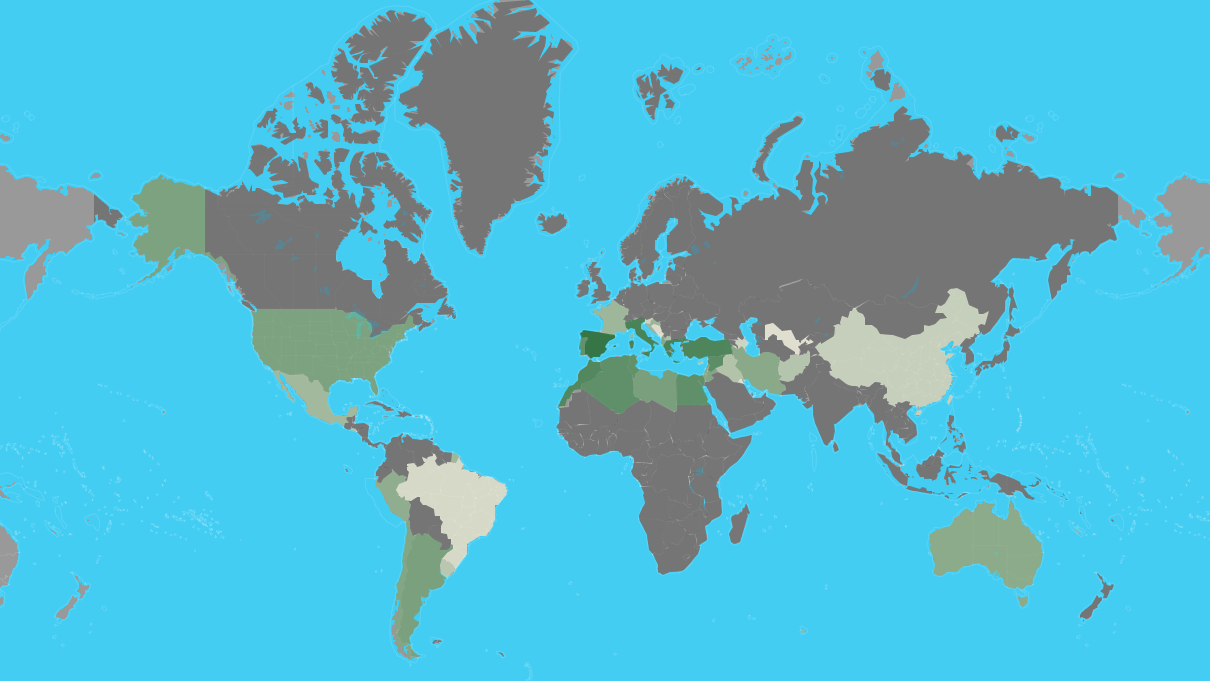
| Rank | Country | Production (Tonnes) | Production per Capita (Kg) | Harvasted Area (Ha) | Yield (Kg/Ha) |
|---|---|---|---|---|---|
| 1 | Spain | 6,559,884 | 141 | 2,573,473 | 2,549 |
| 2 | Greece | 2,343,383 | 218 | 887,177 | 2,641 |
| 3 | Italy | 2,092,175 | 34.6 | 1,165,562 | 1,795 |
| 4 | Turkey | 1,730,000 | 21.4 | 845,542 | 2,046 |
| 5 | Morocco | 1,416,107 | 40.7 | 1,008,365 | 1,404 |
| 6 | Syria | 899,435 | 49.2 | 765,603 | 1,175 |
| 7 | Tunisia | 700,000 | 61.2 | 1,646,060 | 425 |
| 8 | Algeria | 696,962 | 16.4 | 424,028 | 1,644 |
| 9 | Egypt | 694,309 | 7.1 | 67,293 | 10,318 |
| 10 | Portugal | 617,610 | 60.0 | 355,075 | 1,739 |
| 11 | Libya | 188,975 | 29.2 | 357,797 | 528 |
| 12 | Argentina | 175,094 | 3.9 | 61,942 | 2,827 |
| 13 | United States of America | 159,600 | 0.49 | 14,164 | 11,268 |
| 14 | Lebanon | 118,146 | 19.4 | 62,297 | 1,897 |
| 15 | Jordan | 115,813 | 11.3 | 63,963 | 1,811 |
| 16 | Chile | 111,481 | 6.3 | 20,343 | 5,480 |
| 17 | Albania | 99,075 | 34.5 | 38,889 | 2,548 |
| 18 | Palestinian Territories | 95,044 | | 66,645 | 1,426 |
| 19 | Israel | 91,000 | 10.2 | 33,700 | 2,700 |
| 20 | Iran | 85,049 | 1.0 | 66,915 | 1,271 |
| 21 | Australia | 75,083 | 3.0 | 32,747 | 2,293 |
| 22 | Peru | 56,157 | 1.8 | 17,119 | 3,281 |
| 23 | Croatia | 31,183 | 7.4 | 18,184 | 1,715 |
| 24 | France | 27,102 | 0.40 | 17,354 | 1,562 |
| 25 | Mexico | 21,650 | 0.17 | 5,094 | 4,250 |
| 26 | Cyprus | 13,499 | 15.8 | 10,612 | 1,272 |
| 27 | Macedonia | 12,369 | 6.0 | 5,852 | 2,114 |
| 28 | El Salvador | 10,840 | 1.6 | 5,227 | 2,074 |
| 29 | Iraq | 9,332 | 0.24 | 2,294 | 4,068 |
| 30 | Afghanistan | 7,647 | 0.24 | 2,200 | 3,476 |
| 31 | Uruguay | 6,159 | 1.8 | 2,985 | 2,063 |
| 32 | Taiwan | 2,621 | 0.11 | 318 | 8,256 |
| 33 | China | 2,621 | 0.00188 | 318 | 8,256 |
| 34 | Slovenia | 1,662 | 0.80 | 1,173 | 1,417 |
| 35 | Azerbaijan | 1,586 | 0.16 | 2,979 | 533 |
| 36 | Brazil | 647 | 0.00309 | 574 | 1,127 |
| 37 | Bosnia and Herzegovina | 359 | 0.095 | 254 | 1,416 |
| 38 | Montenegro | 250 | 0.40 | 90.0 | 2,778 |
| 39 | Uzbekistan | 116 | 0.00355 | 117 | 987 |
| 40 | Kuwait | 60.0 | 0.014 | 35.0 | 1,702 |
| 41 | Malta | 30.0 | 0.063 | 28.0 | 1,064 |

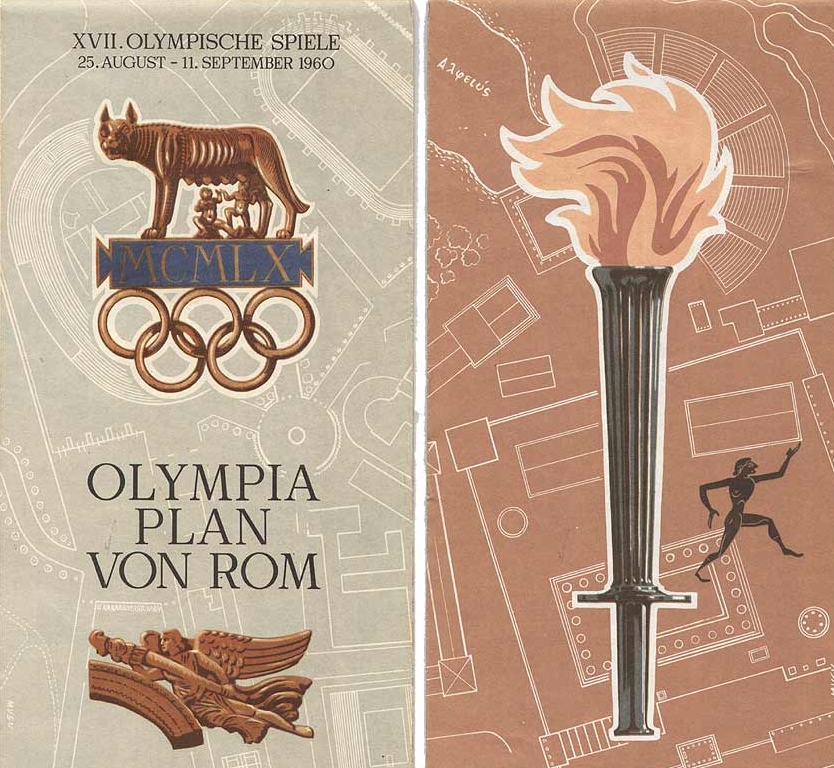
Veranstaltungen Leichtathletik: Olympische Sommerspiele 1960 Europameisterschaften 1974 Golden Gala (seit 1980, Diamond League) Weltmeisterschaften 1987 Europameisterschaften 2024 Fußball: Fußball-Europameisterschaft 1968 Weltpokal 1973 Fußball-Europameisterschaft 1980 Finale Europapokal der Landesmeister 1976/77 Finale Europapokal der Landesmeister 1983/84 Fußball-Weltmeisterschaft 1990 Finale UEFA Champions League 1995/96 Clericus Cup (seit 2007) Finale Coppa Italia (seit 2008) Finale UEFA Champions League 2008/09 Fußball-Europameisterschaft 2021 Rugby: Six Nations (seit 2012) Sonstiges: Konzerte
 Alberta-AB
Australia
Alberta-AB
Australia
 Auvergne-Rhône-Alpes
 Bavaria
Beijing Shi-BJ
Belgium
Berlin
Bosnia Herzegovina
Brazil
Bavaria
Beijing Shi-BJ
Belgium
Berlin
Bosnia Herzegovina
Brazil
 British Columbia-BC
 California-CA
 Cataluña
China
Chūbu
Germany
England
Finland
France
Cataluña
China
Chūbu
Germany
England
Finland
France
 Georgia-GA
Greece
Hebei Sheng-HE
Hokkaidō
Georgia-GA
Greece
Hebei Sheng-HE
Hokkaidō
 Ile-de-France
Italy
Japan
Canada
Kantō
Lazio
Mexico
Ile-de-France
Italy
Japan
Canada
Kantō
Lazio
Mexico
 Missouri-MO
 New South Wales-NSW
 New York-NY
Netherlands
Norwegen
2002 Winter Olympics
2006 Winter Olympics
2010 Winter Olympics
2014 Winter Olympics
2018 Winter Olympics
2022 Winter Olympics
Austria
New York-NY
Netherlands
Norwegen
2002 Winter Olympics
2006 Winter Olympics
2010 Winter Olympics
2014 Winter Olympics
2018 Winter Olympics
2022 Winter Olympics
Austria
 Piemonte
 Quebec-QC
Republic of Korea
Rio de Janeiro
Russia
Schleswig-Holstein
Sweden
Switzerland
Spain
Quebec-QC
Republic of Korea
Rio de Janeiro
Russia
Schleswig-Holstein
Sweden
Switzerland
Spain
 Sport
Sport
 Tyrol
Tyrol
 Utah-UT
 Veneto
United States
United Kingdom
Veneto
United States
United Kingdom
 Victoria-VIC

奥林匹克圣火(英语:Olympic Flame)是奥林匹克运动会的标志。它在古代奥运会上燃烧以纪念古希腊神话中,普罗米修斯从宙斯手中偷来的火。从1928年开始,奥林匹克圣火又重新成为了奥运会的一部分。从1936年柏林奥运会开始出现了圣火传递。它有着传承火焰,生生不息的意义。
Das olympische Feuer ist ein Symbol der olympischen Bewegung. Es ist auch ein Symbol der Kontinuität zwischen den antiken und den modernen Spielen.[1] Das olympische Feuer wird einige Monate vor den Olympischen Spielen in Olympia, Griechenland, entzündet. Mit dieser Zeremonie beginnt der olympische Fackellauf, der offiziell mit dem Entzünden des olympischen Kessels während der Eröffnungsfeier der Olympischen Spiele endet. Die Flamme brennt dann während der gesamten Dauer der Spiele im Kessel weiter, bis sie bei der Abschlusszeremonie gelöscht wird.
Alberta-AB
Argentina
Australia
Auvergne-Rhône-Alpes
Bavaria
Beijing Shi-BJ
Berlin
Bosnia Herzegovina
Brazil
British Columbia-BC
California-CA
Cataluña
China
Chūbu
Germany
England
France
Georgia-GA
Greece
Hokkaidō
Ile-de-France
Italy
Japan
Jiangsu Sheng-JS
Canada
Kantō
Lazio
 Lombardia
Mexico
New South Wales-NSW
New York-NY
Norwegen
Austria
Piemonte
Quebec-QC
Lombardia
Mexico
New South Wales-NSW
New York-NY
Norwegen
Austria
Piemonte
Quebec-QC
 Queensland-QLD
Republic of Korea
Rio de Janeiro
Russia
Switzerland
Senegal
Singapore
Spain
Tyrol
Utah-UT
United States
United Kingdom
Queensland-QLD
Republic of Korea
Rio de Janeiro
Russia
Switzerland
Senegal
Singapore
Spain
Tyrol
Utah-UT
United States
United Kingdom

| 奥林匹克圣歌 | ||
|---|---|---|
| 希腊文歌词 | 英文歌词 | 中文歌词 |
| Αρχαίο Πνεύμ' αθάνατο, αγνέ πατέρα του ωραίου, του μεγάλου και τ'αληθινού, κατέβα, φανερώσου κι άστραψ'εδώ πέρα στην δόξα της δικής σου γης και τ'ουρανού. |
Immortal spirit of antiquity, Father of the true, beautiful and good, Descend, appear, shed over us thy light Upon this ground and under this sky Which has first witnessed thy unperishable fame. |
古代不朽之神, 美丽、伟大而正直的圣洁之父。 祈求降临尘世以彰显自己, 让受人瞩目的英雄在这大地苍穹之中, 作为你荣耀的见证。 |
| Στο δρόμο και στο πάλεμα και στο λιθάρι, στων ευγενών Αγώνων λάμψε την ορμή, και με τ' αμάραντο στεφάνωσε κλωνάρι και σιδερένιο πλάσε κι άξιο το κορμί. |
Give life and animation to those noble games! Throw wreaths of fadeless flowers to the victors In the race and in the strife! Create in our breasts, hearts of steel! |
请照亮跑步、角力与投掷项目, 这些全力以赴的崇高竞赛。 把用橄榄枝编成的花冠颁赠给优胜者, 塑造出钢铁般的躯干。 |
| Κάμποι, βουνά και θάλασσες φέγγουν μαζί σου σαν ένας λευκοπόρφυρος μέγας ναός, και τρέχει στο ναό εδώ, προσκυνητής σου, Αρχαίο Πνεύμ' αθάνατο, Kάθε λαός. |
In thy light, plains, mountains and seas Shine in a roseate hue and form a vast temple To which all nations throng to adore thee, Oh immortal spirit of antiquity! |
溪谷、山岳、海洋与你相映生辉, 犹如以色彩斑斓的岩石建成的神殿。 这巨大的神殿, 世界各地的人们都来膜拜, 啊!永远不朽的古代之神。 |